Making bread at home is much easier when the machine handles mixing, kneading, rising, and baking for you. The best bread machines for beginners combine straightforward controls with dependable results and easy cleanup.
We compared 10 popular models across loaf capacity, preset programs, specialty features, and convenience so you can choose a machine that fits your recipes, kitchen, and budget.
Best 10 Bread Machines for Beginners Picks for 2026
Best Compact Pick
Cuisinart 12-Program Bread Maker

- 12 automatic programs for bread and treats
- Three loaf sizes and three crust colors
- Compact design with LCD and delay timer
Best For: Beginners needing flexible baking in a compact footprint
Best Program Variety
Elite Gourmet 19-Program Bread Maker
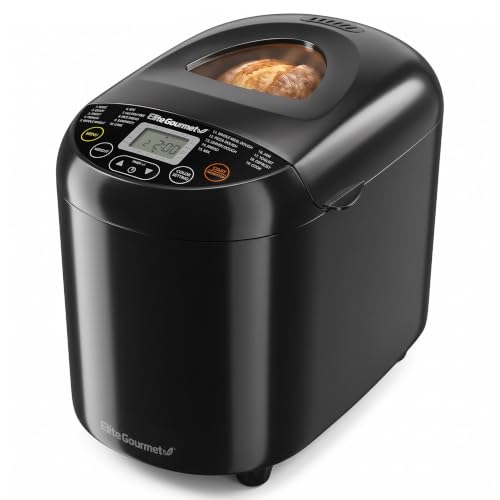
- 19 presets include gluten-free, dough, cake, and jam
- Three loaf sizes up to 2 pounds
- Delay timer and keep-warm function
Best For: Beginners who want guided options for experimenting
Best Large-Capacity Choice

- 2.2-pound capacity for larger batches
- 15 programs with gluten-free and yogurt options
- Automatic fruit-and-nut dispenser and dual heaters
Best For: Beginners baking for families or groups
Best Stainless-Steel Value
Elite Gourmet 19-Program Stainless Bread Maker

- 19 preset programs for varied baking projects
- Three loaf sizes up to 2 pounds
- Stainless-steel exterior with delay timer
Best For: Beginners wanting many presets and a stainless finish
Versatile Starter
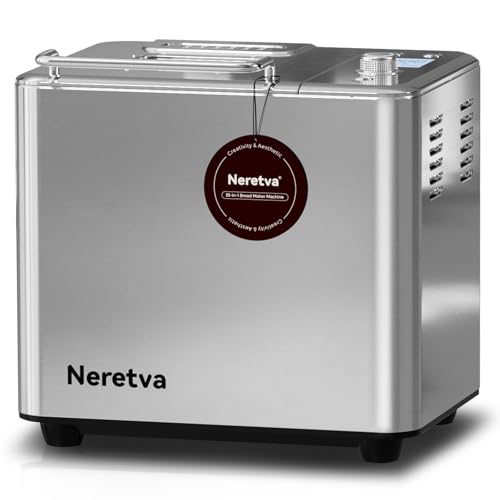
- 20 automatic programs cover breads, doughs, desserts, and more.
- Makes up to 2-pound loaves for five to six people.
- Ceramic pan, delay timer, and included accessories simplify baking.
Best For: Beginners seeking broad functionality and family-size loaves
Precision Beginner Pick
2026 Upgraded 2.5LB Bread Maker

- Built-in scale lets you weigh ingredients in the bread pan.
- 25 programs include sourdough, gluten-free, yogurt, and jam.
- Large 2.5-pound capacity with adjustable crust choices.
Best For: Beginners prioritizing easy measuring and repeatable results
Simple Value Choice
Amazon Basics Programmable Bread Maker

- Automatic cycles handle mixing, kneading, rising, and baking.
- 14 settings include bread, dough, gluten-free options, and jam.
- ExpressBake makes bread in less than 90 minutes.
Best For: First-time users wanting essential features and quick results
Easy-Start Value

- Simple automatic controls for first-time bakers
- Three loaf sizes and three crust settings
- 15-hour delay timer with one-hour keep-warm
Best For: Beginners and families wanting straightforward homemade bread
Most Customizable
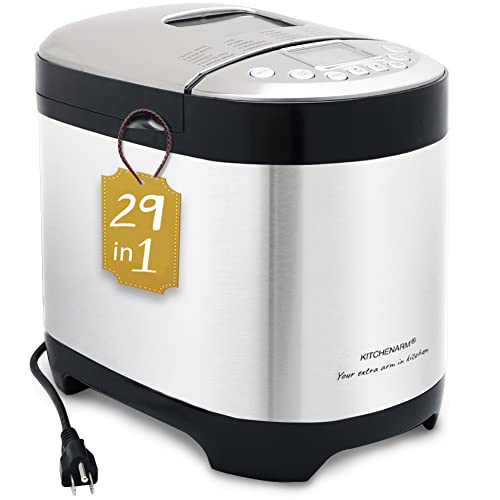
- 29 automatic menus for breads and other foods
- 77 included recipes plus online recipe access
- Saved settings and four personalized menus
Best For: Beginners seeking guided programs and long-term flexibility
Premium Hands-Off Pick

- 17 programs plus custom baking controls
- Automatic dispenser and ceramic pan
- 2.2-pound capacity with convection heating
Best For: Beginners wanting premium convenience and room to experiment
Best Compact Pick – Cuisinart 12-Program Bread Maker
For beginners looking at bread machines for beginners, the Cuisinart CBK-110P1ES offers a straightforward way to mix, knead, rise, and bake without taking over your counter. Its 12 programs, adjustable loaf sizes, and simple LCD display cover everyday bread along with dough, cake, and pizza-making tasks.
Best For: Beginners who want a compact machine with flexible loaf sizes and basic specialty-baking options.
Pros:
- 12 automatic programs include options beyond standard bread.
- Three loaf sizes and three crust colors allow useful customization.
- LCD display, audible reminders, delay timer, and 60-minute keep-warm cycle simplify scheduling.
- Compact vertical design fits more easily on a counter.
Cons:
- Maximum loaf size is 2 pounds.
- The bread pan is specified for hand washing.
The Cuisinart is a practical starting point when ease of use and counter space matter more than having the largest program selection. Its three-year limited warranty is an additional consideration for first-time buyers.
Best Program Variety – Elite Gourmet 19-Program Bread Maker
The Elite Gourmet EBM8103B is a strong option for beginners comparing bread machines for beginners because its one-touch operation handles kneading, rising, and baking. With 19 presets, it also gives new bakers room to try gluten-free bread, pizza dough, cake, jam, and multiple bread styles.
Best For: New users who want the broadest selection of guided programs in a compact, energy-conscious machine.
Pros:
- 19 one-touch programs offer more variety than many basic bread makers.
- Supports 1-, 1.5-, and 2-pound loaves.
- 15-hour delay timer and 60-minute keep-warm function help fit baking into a schedule.
- Compact design avoids heating the entire oven.
Cons:
- Maximum capacity is 2 pounds, so it may be limiting for larger households.
- The supplied model information identifies a 2021 manufacture year.
Choose this model if experimentation is part of your learning plan. Its preset menu reduces the need to develop separate settings for different doughs and baked goods while retaining manageable loaf-size choices.
Best Large-Capacity Choice – Neretva 2.2-Lb Bread Machine
For beginners who expect to bake for several people, the Neretva 2.2LB machine combines automatic programs with a larger stated capacity. Its 15 menus, dual heaters, viewing window, and automatic fruit-and-nut dispenser make it a versatile introduction to bread machines for beginners.
Best For: Households that want larger loaves, specialty programs, and automatic add-ins.
Pros:
- 2.2-pound capacity can serve up to six or seven people, according to the supplied notes.
- 15 programs include gluten-free, sugarless, yogurt, jam, cake, and dough settings.
- Automatic fruit-and-nut dispenser adds ingredients at the intended time.
- Dual heaters, a viewing window, 15-hour timer, and 600-watt motor add convenience.
Cons:
- Its larger capacity and feature set may be more than a solo baker needs.
- The supplied notes specify wiping the machine with a damp cloth rather than dishwasher cleaning.
- At 15.8 pounds, it is relatively heavy to move frequently.
The Neretva makes the most sense when serving size and automation are priorities. It offers more specialized functions than a basic starter machine, but its additional hardware and larger footprint deserve counter-space planning.
Best Stainless-Steel Value – Elite Gourmet 19-Program Stainless Bread Maker
The stainless-steel Elite Gourmet EBM8103SS keeps the beginner experience simple while offering 19 preset programs. It automatically handles kneading, rising, and baking, with settings for different breads and pizza dough plus three loaf sizes for smaller or fuller batches.
Best For: Beginners who prefer a stainless-steel exterior and want broad preset coverage without moving beyond a 2-pound machine.
Pros:
- 19 presets support bread, gluten-free recipes, dough, jam, and pizza dough.
- Three size settings accommodate 1-, 1.5-, and 2-pound loaves.
- 15-hour delay timer and 60-minute keep-warm function support planned baking.
- Automatic operation reduces hands-on work and can free the oven.
Cons:
- Maximum loaf size is 2 pounds.
- The supplied care information calls for wiping with a damp or dry cloth rather than dishwasher cleaning.
This stainless version is a sensible pick for shoppers who want the feature set of a 19-program beginner machine with a metal exterior. It is especially useful when scheduling flexibility matters, though larger households may want more capacity.
Versatile Starter – Neretva 20-in-1 Bread Maker
For shoppers comparing bread machines for beginners, the Neretva combines automatic operation with a broad menu of everyday and specialty options. Its 2-pound capacity, simple preset programs, and included accessories make it a practical choice for learning the basics while experimenting with different recipes.
Best For: Beginners who want a versatile machine for family-size loaves, doughs, jams, yogurt, and other homemade foods.
Pros:
- Offers 20 programs, including basic, quick, French, whole-wheat, gluten-free, cake, dough, jam, and yogurt settings.
- Makes 1.65- or 2-pound loaves, enough to serve about five to six people.
- Includes a ceramic nonstick pan, two kneading paddles, measuring tools, a removal hook, mitt, and recipe book.
- Features a 15-hour delay timer, one-hour keep-warm function, and low operating noise below 40 decibels.
Cons:
- The extensive menu may feel overwhelming until new users become familiar with the settings.
- The control buttons automatically lock during operation and require a three-second press to unlock.
- The supplied dimensions and capacity may take more counter space than a compact bread maker.
The Neretva is a strong all-around introduction to automatic bread making, especially if you want more than basic loaves. Its multiple programs and included tools offer room to grow, while the timer and keep-warm features simplify scheduling.
Precision Beginner Pick – 2026 Upgraded 2.5LB Bread Maker
Among bread machines for beginners, this upgraded model stands out for its built-in electronic scale. You can weigh ingredients directly in the bread pan, then select a program while the machine handles kneading, rising, and baking. That streamlined workflow can make repeatable results easier for first-time bakers.
Best For: Beginners who value weight-based measuring, large loaves, and adjustable fermentation or baking controls.
Pros:
- The built-in digital scale reduces the need for separate measuring tools, bowls, and a standalone kitchen scale.
- Provides 25 programs, including gluten-free, sourdough, yogurt, jam, and whole-wheat options.
- Supports 1-, 1.5-, and 2.5-pound loaves with light, medium, or dark crust choices.
- Includes a 15-hour delay timer, 60-minute keep-warm period, power-memory feature, and overheat protection.
Cons:
- At 11.5 pounds and roughly 12.2 inches in each listed dimension, it may be bulky for smaller kitchens.
- The most useful fermentation and baking adjustments are available only on selected programs.
- The larger 2.5-pound capacity may be more than needed for households that prefer small loaves.
This model is particularly beginner-friendly if measuring ingredients is the part of bread making that feels tedious or uncertain. Its larger capacity and adjustable settings also give more experienced users flexibility, although the footprint is worth checking before purchase.
Simple Value Choice – Amazon Basics Programmable Bread Maker
If you want a straightforward entry point into bread machines for beginners, the Amazon Basics Programmable Bread Maker keeps the process simple. It automatically mixes, kneads, rises, and bakes, while 14 settings cover everyday bread, dough, gluten-free options, jams, and quick ExpressBake recipes.
Best For: First-time users who want an uncomplicated 2-pound machine with essential programs and fast-bake capability.
Pros:
- Automatic mixing, kneading, rising, and baking make the basic workflow easy to follow.
- Offers 14 settings, including bread, dough, gluten-free options, jam, and other preparations.
- ExpressBake can produce bread in less than 90 minutes.
- Includes three crust-color choices and a nonstick bread pan.
Cons:
- It has fewer programs than the Neretva and upgraded 2026 model.
- The supplied notes do not mention a delay timer or keep-warm function.
- Its 2-pound capacity is less suitable for users specifically seeking extra-large family loaves.
The Amazon Basics model is a sensible choice when you prefer essential controls over a long list of specialty features. Its ExpressBake setting is useful for quicker results, while the 2-pound capacity suits many everyday households.
Easy-Start Value – 17-in-1 Bread Maker
For shoppers comparing bread machines for beginners, this 2-pound model keeps the process straightforward: add ingredients, choose a program, and let the machine knead and bake. Its 17 programs, three loaf sizes, and three crust settings provide useful flexibility without requiring baking experience.
Best For: Beginners and families who want an uncomplicated bread maker with a large capacity and basic customization.
Pros:
- Simple automatic operation with 17 programs, including basic, whole wheat, gluten-free, cake, jam, and yogurt.
- Supports 1-, 1.5-, and 2-pound loaves with light, medium, or dark crust settings.
- Includes a 15-hour delay timer, one-hour keep-warm function, non-stick pan, and beginner-friendly controls.
- 600W operation, 360-degree heat distribution, and a stated noise level of 50 decibels.
Cons:
- Its 17 programs offer less menu variety than some more advanced bread machines.
- The manufacturer recommends hand washing the removable components.
- Basic-cycle baking takes about 3 hours 35 minutes to 3 hours 45 minutes, depending on loaf size.
This is a practical entry-level choice for anyone who values easy controls and family-size loaves over extensive recipe programming. The delay timer and keep-warm feature also make it convenient for scheduled breakfasts or evening baking.
Most Customizable – 29-in-1 Smart Bread Machine
Among bread machines for beginners, the KITCHENARM stands out for guided variety and repeatable settings. Its 29 automatic menus cover common breads, specialty diets, and non-bread recipes, while saved settings can turn a familiar recipe into a one-press routine.
Best For: Beginners who want extensive recipe guidance now and room to customize recipes later.
Pros:
- Offers 29 menus, including basic, whole wheat, gluten-free, sourdough, keto, cake, jam, and yogurt.
- Includes 77 recipes and access to additional recipes through the KitchenArm Recipe Cloud.
- Supports three loaf sizes, three crust colors, a 15-hour delay timer, and one-hour keep-warm.
- Home Made programming allows custom cycle times and up to four personalized menus.
Cons:
- The large number of menus and customizable settings may feel more involved than a basic starter machine.
- Hand washing is specified in the product-care information.
- The machine is designed for 120V, 60Hz North American power.
The saved-setting feature makes this model unusually approachable for repeat baking, while its custom menu gives growing bakers plenty to explore. It is a strong fit if you want beginner-friendly automation without outgrowing the machine quickly.
Premium Hands-Off Pick – KBS Pro 2.2LB Bread Maker
For beginners who want a more feature-rich countertop appliance, the KBS Pro combines automatic programs with a ceramic pan, convection heating, and an ingredient dispenser. The controls are designed for one-touch selection, while the included recipe book provides a starting point for experimenting.
Best For: New bakers who want a premium-feeling machine with larger capacity and automatic mix-in handling.
Pros:
- Provides 17 programs plus a custom setting, with 53 recipes included.
- 2.2-pound maximum capacity and three loaf sizes accommodate different household needs.
- Automatic stainless steel dispenser adds ingredients during baking for a more hands-off process.
- Ceramic pan and paddle, 710W motor, 360-degree convection heating, 15-hour timer, and one-hour keep-warm function.
Cons:
- The premium feature set may be more than beginners need for basic bread.
- Manual customization requires more involvement than using a fully automatic preset.
- Its larger 2.2-pound capacity may be unnecessary for shoppers who usually bake small loaves.
This model is a compelling upgrade for beginners who prioritize convenience, specialty programs, and a larger loaf. The automatic dispenser and ceramic baking pan add useful hands-off features, while the custom setting leaves room to develop more advanced recipes.
How We Picked the Best Bread Machines for Beginners
We focused on features that make the first few loaves less intimidating: clearly labeled programs, automatic timing, practical loaf sizes, nonstick pans, and accessible controls. We also considered useful extras such as gluten-free cycles, dough-only settings, delayed start, automatic ingredient dispensers, dual heating elements, and built-in scales.
Preset count was not the only deciding factor. A machine with 29 programs may offer more flexibility, but a simpler 12- or 14-program model can be easier to learn. We weighed versatility against likely day-to-day usability, especially for people who want reliable sandwich bread, dough for rolls or pizza, and occasional specialty recipes.
Quick Comparison
Most models in this roundup make approximately 2-pound loaves, while some offer smaller or larger options. Stainless-steel models may suit shoppers prioritizing appearance and durability, while black or compact designs can be a better fit for limited counter space. Machines with automatic nut dispensers are convenient for add-ins, whereas a built-in scale can reduce measuring steps.
- Best for straightforward operation: Choose a model with a modest number of clearly organized programs.
- Best for variety: Look for multiple loaf sizes, gluten-free options, and customizable or homemade cycles.
- Best for add-ins: An automatic nut or fruit dispenser helps distribute ingredients at the right stage.
- Best for consistent measuring: A built-in electronic scale can simplify ingredient preparation.
- Best for even baking: Dual-heater designs may help improve browning and reduce uneven results.
Key Buying Factors for Bread Machines for Beginners
Capacity and Loaf Shape
A 2-pound machine is a practical starting point for most households. Check whether it also supports 1- or 1.5-pound loaves if you bake for fewer people, and confirm the finished loaf shape will fit your preferred slices or storage container.
Programs and Controls
Prioritize bread, whole wheat, rapid, dough, and bake-only settings before chasing the highest preset count. Gluten-free cycles matter if you regularly use gluten-free mixes, while a homemade cycle is valuable for experienced users who want control over kneading, rising, and baking times.
Cleanup and Maintenance
A removable nonstick pan and removable kneading paddle make cleanup easier. Follow the manufacturer’s instructions rather than soaking electrical components or using abrasive tools that could damage the coating.
Convenience Features
Delayed start, keep-warm functions, viewing windows, ingredient dispensers, and power-failure memory can make scheduled baking more practical. Remember that delayed-start recipes should use ingredients that can safely sit in the pan for the programmed period.
Who Should Buy Which Bread Machines for Beginners?
First-time bakers who want minimal setup should choose a straightforward programmable model with essential cycles and a removable nonstick pan. Families or frequent bakers may prefer adjustable loaf sizes and stronger capacity. Shoppers experimenting with recipes should consider a machine with a homemade cycle and more comprehensive program selection. Choose a dispenser-equipped model if you often add nuts, fruit, or seeds, and consider a built-in-scale model if measuring flour accurately is a recurring frustration.
Before buying, measure your available counter and storage space, verify the machine’s voltage and included accessories, and check whether replacement pans or paddles are available. The best choice is the model whose everyday controls and capacity match how you actually plan to bake.
