Finding the right chocolate tempering machine can make dipping, molding, and decorating far more consistent. The best beginner models simplify temperature control without demanding commercial-level experience or complicated setup.
This roundup compares 10 options across compact countertop pots, dual-tank melters, and higher-capacity machines, so you can match equipment to your batch size, workspace, and budget.
Best 10 Chocolate Tempering Machines for Beginners Picks for 2026
Flexible Dual-Pot Pick

- Two independent heating pots
- Smart thermostat temperature control
- Melts up to 1 kg in 10–15 minutes
Best For: Beginners making multiple chocolate types at home or in a small café
High-Capacity Starter
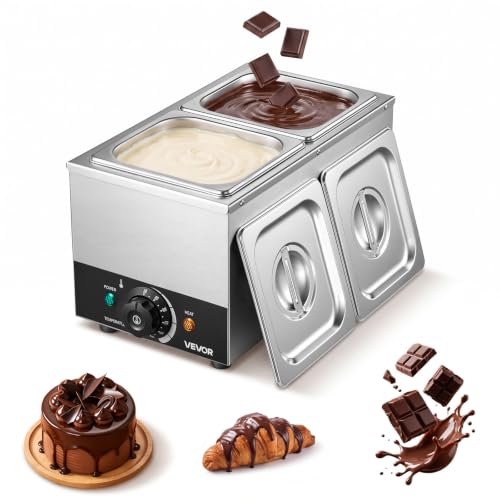
- Two 9-pound-capacity melting sections
- Water-bath heating for even melting
- Temperature range of 86–185°F
Best For: High-volume baking, dessert service, and large chocolate batches
Easy Home Treat Maker

- Two heat settings for melting and warming
- Dual and standard insert pots included
- Food-grade silicone with easy cleanup
Best For: Families and hobbyists making small batches of dipped chocolate treats
Precision Tempering Upgrade

- Automatic melt, temper, set, and hold functions
- 1.5-pound chocolate capacity
- LED display with precise temperature control
Best For: Beginners seeking dedicated, repeatable tabletop tempering
Best Budget-Friendly Pick

- Fast, even PTC heating
- Removable nonstick pot
- Temperature and safety protection
Best For: Home users and small-batch beginners
Best Large-Capacity Option
26.46-Pound Stainless Steel Melter

- Holds up to 26.46 pounds
- 32–203°F adjustable range
- Digital controls with five heating plates
Best For: Large batches and light commercial use
Best for Two Ingredients

- Two independent 1.8-quart tanks
- 800W water-bath heating
- Automatic temperature maintenance
Best For: Simultaneous chocolate and cream or milk preparation
Balanced Dual-Tank Pick
1000W Dual-Cylinder Chocolate Melter

- Two cylinders for separate ingredients
- 86°F–185°F manual temperature control
- Stainless steel water-bath heating design
Best For: Beginners needing two simultaneous melting zones
High-Capacity Workhorse
2000W Four-Tank Chocolate Melter

- Four independent tanks for multiple ingredients
- 2000W water-bath heating system
- Adjustable range from 86°F to 185°F
Best For: High-volume home or small-business dessert stations
Lidded Compact Option
800W Dual-Tank Tempering Machine

- Dual independent tanks with lids
- 86°F–185°F temperature adjustment
- Stainless steel body for daily use
Best For: Home users making small-batch chocolate and sauces
Flexible Dual-Pot Pick – Dual Chocolate Melter
For beginners comparing chocolate tempering machines for beginners, this dual-pot electric melter offers a straightforward way to work with two chocolate types at once. Separate controls and a built-in thermostat help keep each pot at its selected temperature.
Best For: Home confectioners and small cafés making multiple chocolate coatings, candies, or dessert decorations.
Pros:
- Two independently heated pots can handle different chocolates simultaneously.
- Smart thermostat monitoring is designed to reduce scorching and uneven melting.
- Melts up to 1 kg in approximately 10–15 minutes, according to the supplied notes.
- Ceramic-coated pots and a stainless-steel exterior are designed for easier cleanup and food-safe use.
Cons:
- The supplied information describes melting and warming features rather than a fully automatic tempering cycle.
- Its two-pot design may be more equipment than beginners need for occasional single-batch work.
This is a practical choice when flexibility matters more than hands-off tempering. The dual controls are especially useful for dipping, layered decorations, and recipes requiring different chocolate varieties.
High-Capacity Starter – VEVOR 9-Lb Chocolate Melter
If you need a beginner-friendly entry into chocolate tempering machines for beginners but expect larger batches, this VEVOR model provides two pots and up to 9 pounds of total capacity. Its water-bath heating system is designed for even melting during extended use.
Best For: Bakeries, dessert shops, buffets, and serious home users who need bulk chocolate for peak periods.
Pros:
- Two pots can hold different chocolates and support flexible batch preparation.
- Water-bath heating and U-shaped tubes are designed to melt chocolate evenly from edge to center.
- Precision temperature sensing automatically adjusts heat across an 86–185°F range.
- Low-water auto shutoff and dry-burn protection support longer operation.
Cons:
- A 9-pound capacity and 800W power may be excessive for occasional small batches.
- The supplied features emphasize melting and warming; no automatic crystallization tempering cycle is specified.
- Its commercial size takes more counter space than a compact hobby melter.
This model makes the most sense when capacity and steady temperature control are priorities. Beginners should consider it if they are learning with frequent, high-volume projects rather than small treats.
Easy Home Treat Maker – 4-Cup Chocolate Melting Pot
For newcomers exploring chocolate tempering machines for beginners, this compact 4-cup melter focuses on simple home projects such as cake pops, cocoa bombs, dipped treats, and fondue. It includes two insert options and a spatula for flexible small-batch work.
Best For: Families, casual hobbyists, and beginners making modest batches of dipped or molded chocolate.
Pros:
- Two heat settings support melting and keeping chocolate warm.
- Dual and standard insert pots allow two flavors or a larger single batch.
- Supplied timing indicates about 10–15 minutes for common 2½- to 3½-cup batches.
- Food-grade silicone and dishwasher-safe insert components simplify handling and cleanup.
Cons:
- The notes recommend continuous stirring and close monitoring to prevent overheating.
- Its 4-cup capacity is better suited to home batches than commercial production.
- The supplied information does not specify an automatic tempering program.
This is the most approachable option for hands-on beginners who value easy cleanup and included accessories. It is a melter and warmer rather than a clearly automated tempering machine, so users may need separate tempering technique for finished chocolate.
Precision Tempering Upgrade – Revolation 2
Among chocolate tempering machines for beginners, the Revolation 2 is the most purpose-built option for learning a repeatable tempering workflow. Its microprocessor-controlled forced hot air system melts, tempers, sets, and holds up to 1.5 pounds of chocolate.
Best For: Beginners who want a dedicated tabletop tempering machine for smaller professional-style batches.
Pros:
- Designed to melt, temper, set, and hold chocolate in one tabletop unit.
- Microprocessor control and forced hot air provide automatic operation.
- LED temperature display supports monitoring to 2/10 of a degree Fahrenheit.
- Removable bowl and baffle make the working components easier to access.
Cons:
- Its 1.5-pound capacity is substantially smaller than commercial multi-pound melters.
- The supplied daily output is 10 pounds, so it may be limiting for high-volume service.
- A dedicated tempering machine may cost more or offer more capability than casual users need.
This is the strongest match for beginners who specifically want automated tempering rather than basic melting. The smaller capacity keeps it tabletop-friendly, while the precise display and dedicated cycle make it suitable for developing consistent technique.
Best Budget-Friendly Pick – Compact Chocolate Melting Pot
For beginners comparing chocolate tempering machines for beginners, this compact melting pot offers straightforward controls, fast heating, and a removable nonstick pot that simplifies cleanup. Its temperature controller and constant-temperature protection are useful for small-batch home projects or light shop use.
Best For: Beginners making chocolate, cream, milk, or similar ingredients at home or in a small bakery, café, or shop.
Pros:
- Food-grade aluminum provides fast heat conduction and resists rust and corrosion.
- PTC heating elements are designed for efficient, even heating.
- Removable nonstick pot makes cleanup easier.
- Temperature control includes constant-temperature and power-off protection features.
Cons:
- The supplied notes do not specify the pot’s capacity.
- Its compact 4-pound design may be less suitable for high-volume production.
This is a practical entry-level option when convenience and a small footprint matter more than commercial-scale capacity. The simple controls and easy-clean pot make it approachable for first-time users.
Best Large-Capacity Option – 26.46-Pound Stainless Steel Melter
Beginners who expect to make larger batches may prefer this stainless steel machine when shopping for chocolate tempering machines for beginners. It has a digital control panel, a broad 32–203°F temperature range, and five heating plates intended to support even melting without adding water.
Best For: Home or commercial users who need a large-capacity melter for chocolate, cream, milk, butter, jam, or similar ingredients.
Pros:
- Large 26.46-pound capacity suits bigger batches.
- 201 stainless steel construction is sturdy, wear-resistant, and easy to rinse.
- Temperature adjusts from 32°F to 203°F.
- One-touch operation, digital display, lid, and non-slip feet add convenience.
Cons:
- The notes indicate a temperature difference of about 41°F from the set temperature.
- Its large capacity and 26.46-pound weight may be excessive for occasional home use.
This model is more focused on capacity and commercial-style durability than compactness. Its controls are beginner-friendly, but users should account for the stated temperature variation when working on recipes that require tight temperature control.
Best for Two Ingredients – Dual-Tank Chocolate Melter
This dual-tank machine is a useful choice for beginners comparing chocolate tempering machines for beginners who want to heat two ingredients at once. Its two independent 1.8-quart tanks, 800W heating system, and automatic temperature cycling make it suitable for chocolate alongside milk, cream, or another ingredient.
Best For: Beginners who need separate, simultaneous heating for chocolate and milk, cream, butter, sauces, or similar ingredients.
Pros:
- Two independent 1.8-quart tanks support simultaneous preparation.
- 800W power and water-bath heating provide rapid, even heating.
- Temperature adjusts from 86°F to 185°F.
- Built-in probe automatically alternates heating and stopping to maintain temperature.
Cons:
- Each tank is limited to 1.8 quarts, so it is not designed for very large batches.
- The 10.8-pound unit is less compact than a basic single-pot model.
The independent tanks make this a flexible beginner machine for recipes requiring multiple melted components. It is especially practical for small professional kitchens or home users who value workflow efficiency over a single large reservoir.
Balanced Dual-Tank Pick – 1000W Dual-Cylinder Chocolate Melter
For beginners comparing chocolate tempering machines for beginners, this 1000W model offers a practical mix of capacity, adjustability, and straightforward water-bath heating. Its two cylinders can handle different ingredients at the same time, while the stainless steel construction is designed for regular use and easier cleanup.
Best For: Beginners who want to melt two chocolates or food ingredients simultaneously at home, in a bakery, or in a small café.
Pros:
- Dual-cylinder design supports white and dark chocolate at the same time.
- Adjustable temperature range from 86°F to 185°F.
- 1000W U-shaped heating tube and water-bath heating promote even warming.
- Stainless steel construction is rust-resistant, heat-resistant, and easy to clean.
Cons:
- Its two-cylinder capacity is smaller than the four-tank alternative.
- At 8.03 pounds, it may still be more machine than occasional users need.
This is a sensible starting point when you want separate heating compartments without moving immediately to a larger commercial unit. The manual thermostat and water-bath design are especially useful for learning controlled melting.
High-Capacity Workhorse – 2000W Four-Tank Chocolate Melter
Among chocolate tempering machines for beginners, this four-tank model is aimed at users who need more simultaneous capacity. Its 2000W heating system, adjustable thermostat, and water-bath design make it suitable for preparing multiple chocolate or warming tasks in a commercial-style setup.
Best For: Beginners setting up a busy dessert station, bakery, café, or chocolate shop that needs four independent tanks.
Pros:
- Four-cylinder design provides more simultaneous working capacity.
- 2000W power supports rapid heating with a U-shaped heating tube.
- Temperature can be adjusted from 86°F to 185°F.
- Stainless steel body is rust-resistant and relatively easy to clean.
Cons:
- At 13.62 pounds, it is heavier and less portable than the smaller models.
- The larger four-tank format may be excessive for occasional home use.
Choose this model when capacity matters more than compactness. It can streamline multi-ingredient preparation, but its larger footprint and higher power make it better suited to a dedicated workspace.
Lidded Compact Option – 800W Dual-Tank Tempering Machine
For beginners seeking chocolate tempering machines for beginners with a simple dual-zone layout, this 800W Takywep model offers independent tanks, included lids, and adjustable temperature control. It is designed for chocolate, milk, coffee, cheese, sauces, and other gentle warming tasks.
Best For: Home cooks and new confectioners who want covered dual tanks for small-batch recipes and general food warming.
Pros:
- Two independent tanks allow chocolate and milk or cream to warm simultaneously.
- Included lids can help with temperature control during use.
- Temperature adjusts from 86°F to 185°F for varied applications.
- Stainless steel construction is rust-resistant and designed for easy cleaning.
Cons:
- Its 800W output is lower than the 1000W and 2000W alternatives.
- The dual-tank format offers less capacity than a four-tank machine.
This is a practical choice if you value covered containers and a versatile two-tank setup. Its lower wattage may suit smaller batches, while the wide temperature range supports both confectionery and savory warming tasks.
How We Picked the Best Chocolate Tempering Machines for Beginners
We evaluated these machines around the needs most likely to matter to first-time users: straightforward controls, usable temperature ranges, even heating, practical capacity, food-safe construction, and cleanup effort. We also considered whether each design suits small home batches, regular gifting and party work, or higher-volume production.
Because product specifications can vary by seller and model version, confirm the listed wattage, tank capacity, temperature range, included inserts, voltage, and warranty before ordering. A machine marketed as a melter may not provide the same precision as a true tempering system.
Quick Comparison
| Best For | Look For | Ideal Machine Type |
|---|---|---|
| Occasional home projects | Compact size and simple controls | Single-pot or small insert-pot melter |
| Two chocolate types at once | Separate temperature control or tanks | Dual-tank machine |
| Frequent small-batch work | Stable heating and easy cleaning | Stainless-steel countertop melter |
| Events or small business use | Higher capacity and stronger output | Commercial multi-tank machine |
Key Buying Factors for Chocolate Tempering Machines for Beginners
Temperature Control
Accurate, adjustable heat is the most important feature. Look for a clear thermostat or digital control that lets you melt gently rather than relying on high heat. Remember that dark, milk, and white chocolate have different working requirements, so a broad, controllable range is more useful than maximum temperature alone.
Capacity and Tank Layout
Choose capacity based on your normal batch size, not the largest project you might make once a year. Small pots reduce waste and warm up quickly; dual or four-tank designs are better when you need multiple chocolates or colors ready at the same time.
Heating Method and Consistency
Water-bath heating can reduce hot spots and is often forgiving for beginners, while direct electric heating may be faster and simpler. Whichever style you choose, stir periodically and use a separate thermometer when precision matters.
Cleaning and Safety
Removable inserts, lids, stainless-steel interiors, insulated handles, and over-temperature protection can make regular use easier. Never add water to melted chocolate, and check whether parts are removable or dishwasher-safe before buying.
Who Should Buy Which Chocolate Tempering Machines for Beginners?
Choose a compact single-pot or insert-pot model if you are learning chocolate work, making occasional treats, or have limited counter space. A dual-tank machine is the practical middle ground for home bakers who regularly work with two chocolate types. If you sell confections, prepare party favors, or need long operating sessions, prioritize a commercial machine with larger capacity, durable construction, and dependable temperature control.
For most beginners, the best choice is not the largest or most powerful model. Select the smallest machine that comfortably handles your usual batches, offers controls you can understand, and can be cleaned without frustration.
