Fresh citrus juice can improve drink quality while adding prep time, cleanup, and equipment costs. The right juicer helps a small business serve consistently without taking up more counter space than necessary.
We selected 10 electric and manual options for cafés, bars, restaurants, bakeries, juice stands, and mobile setups, with attention to capacity, extraction speed, pulp control, durability, and cleanup.
Best 10 Citrus Juicers for Small Businesses Picks for 2026
Premium Quiet Pick
Eurolux Electric Citrus Juicer

- 300W motor with quiet 110 RPM operation
- One-touch, hands-free extraction
- Dishwasher-safe removable parts
Best For: Small cafés and shared workspaces
Best Capacity Value
BLACK+DECKER CJ625 Citrus Juicer

- 32-ounce clear juice container
- Adjustable pulp control with removable basket
- Auto-reversing cones and drip-free spout
Best For: Measured small-batch preparation
Best Manual Flexibility

- Interchangeable reamers for small and large citrus
- 350 ml capacity with measurement markings
- Compact, nestable parts for storage
Best For: Low-volume manual juicing
Compact Batch Pick
Elite Gourmet ETS623 Citrus Juicer

- 24-ounce capacity for small batches
- 40W auto-reversing motor
- Pulp and seed filter with pour spout
Best For: Compact café and office setups
Best Handheld Power

- Dual-gear design helps extract more juice with less hand strain.
- Durable nylon and stainless-steel construction.
- Top-rack dishwasher safe and compact for drawer storage.
Best For: Small-batch lemon and lime prep in cafés, bars, and kitchens
Best for Measured Portions
OXO Good Grips Small Citrus Juicer

- Integrated 2.5-ounce cup includes measurement markings.
- Stable reamer and drip-free pour spout support tidy prep.
- Disassembles for cleaning and is dishwasher safe.
Best For: Measured citrus juice for recipes, baking, and cocktails
Best Electric Batch Option
LEBENLANG 24-Ounce Citrus Juicer

- Electric two-direction rotation reduces manual effort.
- Two cones handle oranges, lemons, limes, and grapefruits.
- 24-ounce removable container includes a measuring scale.
Best For: Small operations preparing several servings of citrus juice
Compact Manual Pick

- 12-ounce measuring container
- Multiple reamers for different citrus sizes
- Compact flip-top design
Best For: Small-batch drinks, marinades, and portable prep
Adjustable Electric Choice

- Three adjustable pulp settings
- Handles limes through grapefruits
- Auto-reversing cone and final spin
Best For: Regular café or bar service with varied citrus orders
Heavy-Duty Manual Pick
Etinslant Stainless Steel Juicer
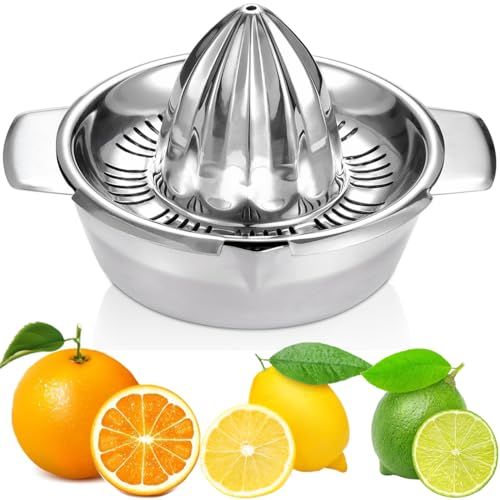
- 304 stainless-steel construction
- Two pour spouts with slotted strainer
- Compact 10-ounce manual design
Best For: Portable service and durable individual-serving prep
Premium Quiet Pick – Eurolux Electric Citrus Juicer
For small businesses seeking citrus juicers for small businesses, the Eurolux combines one-touch operation with a powerful 300W motor. Its stainless steel build, quiet operation, and compact footprint suit counters where speed, presentation, and noise control matter.
Best For: Small cafés, juice bars, and shared workspaces that need hands-free electric juicing.
Pros:
- 300W motor and 110 RPM operation support efficient extraction.
- One-touch, hands-free design simplifies repeated juicing.
- Detachable food-contact parts are top-rack dishwasher safe.
- Compact stainless steel body has a stable base and BPA-free components.
Cons:
- Its compact design may be better suited to smaller batches than high-volume production.
- It is a corded countertop appliance, so it needs a dedicated outlet and counter space.
The Eurolux is a strong fit when a small operation values quiet, convenient extraction and easy cleanup. Its feature set is more focused on countertop efficiency than large-capacity service.
Best Capacity Value – BLACK+DECKER CJ625 Citrus Juicer
The BLACK+DECKER CJ625 is a practical choice for small businesses comparing citrus juicers for small businesses on a budget. Its 32-ounce container, adjustable pulp control, and clear measurement markings make it useful for preparing measured batches and serving directly from the pitcher.
Best For: Small cafés, catering prep, and businesses that want a simple batch-oriented juicer.
Pros:
- 32-ounce container provides useful capacity for small batches.
- Auto-reversing cones help extract juice efficiently.
- Adjustable pulp control and a removable pulp basket support customized serving.
- Measurement markings and a drip-free pour spout improve recipe preparation and serving.
Cons:
- The plastic construction may feel less substantial than stainless steel alternatives.
- Its 150W listed wattage is less powerful than the Eurolux model in this roundup.
Choose the CJ625 when capacity, measurements, and pulp control matter more than premium materials. The pitcher-style container can streamline prep and pouring for modest service volumes.
Best Manual Flexibility – OXO Good Grips 2-in-1 Juicer
For businesses that only need occasional fresh citrus, the manual OXO Good Grips 2-in-1 is a space-efficient alternative to electric citrus juicers for small businesses. Interchangeable reamers handle small and large fruit, while measurement markings and a drip-free spout support straightforward prep.
Best For: Low-volume cafés, food stalls, bars, and businesses that prefer a quiet manual tool.
Pros:
- Small and large reamers accommodate lemons, limes, oranges, and grapefruit.
- Measurement markings reach 1.5 cups or 350 ml.
- Built-in strainer and pulp-control design help manage the finished juice.
- Reamers snap off for cleaning and nest for storage.
Cons:
- Manual operation requires more user effort than electric models.
- The 350 ml capacity is limited for larger service periods.
The OXO is best for controlled, lower-volume tasks where compact storage and fruit flexibility are priorities. It is less suitable when staff need to process repeated batches quickly.
Compact Batch Pick – Elite Gourmet ETS623 Citrus Juicer
The Elite Gourmet ETS623 offers a compact middle ground for small businesses evaluating citrus juicers for small businesses. Its 24-ounce capacity, 40W motor, auto-reversing reamer, and integrated pulp and seed filter support small batches without taking much counter space.
Best For: Small kitchens, cafés, offices, and mobile setups needing compact electric batch juicing.
Pros:
- 24-ounce, three-cup capacity handles modest batches.
- Auto-reversing extraction supports juice yield from multiple citrus types.
- Integrated pulp and seed filter plus pour spout simplify serving.
- Compact BPA-free design is ETL listed and has a quiet motor.
Cons:
- Its 40W motor is less powerful than higher-wattage commercial-style options.
- The 24-ounce capacity may require refilling during busier service.
- Supplied details recommend hand washing for the longest product life, despite removable parts being described as top-rack dishwasher safe.
The ETS623 makes sense when footprint and moderate batch capacity are more important than maximum throughput. It provides useful electric features for lighter-duty business service.
Best Handheld Power – FreshForce Lemon Squeezer
For citrus juicers for small businesses that prioritize speed and low-effort manual prep, the Chef’n FreshForce is a practical choice for lemons, key limes, and similar small citrus. Its dual-gear design is intended to extract more juice while reducing hand strain.
Best For: Cafés, cocktail bars, and kitchens primarily juicing lemons and limes to order.
Pros:
- Dual-gear mechanism provides up to 20% more juice than standard squeezers, according to the supplied product information.
- Comfortable non-slip handles help reduce pressure on hands.
- Nylon and stainless-steel construction is designed for repeated everyday use.
- Top-rack dishwasher-safe design simplifies cleanup.
Cons:
- Manual operation may be slower than an electric juicer for larger batches.
- Designed mainly for lemons, key limes, and other small citrus rather than high-volume orange juicing.
- Its compact basket has a stated capacity of 0.8 liters, limiting how much can be processed at once.
The FreshForce makes sense when staff need precise, fresh juice without plugging in a machine. Its ergonomic design is especially useful for frequent small-batch service, though businesses handling many oranges or grapefruits may want a larger electric model.
Best for Measured Portions – OXO Good Grips Small Citrus Juicer
For citrus juicers for small businesses that need accurate portions for recipes, baking, or drinks, the OXO Good Grips Small Citrus Juicer combines a reamer with a built-in 2.5-ounce measuring cup. Its compact format suits low-volume prep and counter space where simplicity matters.
Best For: Bakeries, cafés, and prep stations measuring small amounts of lemon, lime, or orange juice.
Pros:
- Built-in measurement markings support consistent recipe and beverage preparation.
- Reamer dish fits securely onto the cup for stability while juicing.
- Drip-free pour spout helps transfer juice neatly.
- Disassembles for cleaning and is listed as dishwasher safe.
Cons:
- The 2.5-ounce cup is better suited to small portions than batch production.
- Manual reaming requires hands-on effort.
- It may be less suitable when a business regularly juices whole batches of oranges or grapefruit.
The OXO is a useful precision tool rather than a high-volume production juicer. Choose it when measured quantities, clean pouring, and easy storage are more important than maximum throughput.
Best Electric Batch Option – LEBENLANG 24-Ounce Citrus Juicer
For citrus juicers for small businesses that need hands-free assistance and more capacity, the LEBENLANG electric juicer offers two cone sizes and a 24-ounce container. Its two-direction rotation is designed for oranges, lemons, limes, and grapefruits with minimal manual force.
Best For: Small cafés, breakfast counters, and offices preparing several glasses of citrus juice at a time.
Pros:
- Electric operation requires only light pressing rather than repeated hand squeezing.
- Two cone sizes accommodate different citrus fruits.
- Removable 24-ounce container includes a measuring scale.
- Pulp sieve, non-slip feet, and dishwasher-safe individual parts support convenient use.
Cons:
- Its 220-volt corded specification may not suit every business’s electrical setup.
- At 40 watts and 700 ml capacity, it is still intended for modest rather than industrial-scale output.
- The supplied details list hand washing for care, despite noting dishwasher-safe individual parts, so cleaning instructions should be checked carefully.
The LEBENLANG is the strongest fit here for reducing repetitive manual work and preparing multiple servings. Its larger container and electric drive offer more throughput than handheld tools, while the compact design remains appropriate for small operations.
Compact Manual Pick – Drizom Citrus Hand Juicer
For small businesses needing citrus juicers for small businesses without using counter space or electricity, the Drizom is a compact manual option. Its 12-ounce measuring container, multiple reamers, and flip-top design suit made-to-order drinks, marinades, and kitchen prep.
Best For: Cafés, food stalls, caterers, and businesses that need modest-volume manual juicing with built-in measuring.
Pros:
- 12-ounce/400 ml container includes cup, ounce, and milliliter markings.
- Small and storage-friendly flip-top design can also separate egg yolks.
- Includes reamers for smaller citrus and larger fruits such as oranges.
- Top-rack dishwasher cleaning is listed as an option.
Cons:
- Manual operation may be slower and more labor-intensive for busy service.
- Its 12-ounce capacity is better suited to small batches than continuous production.
- The supplied details also list hand washing in the care instructions, so cleaning guidance is somewhat inconsistent.
This is a practical choice when portability, measurement control, and multifunctional prep matter more than high-volume throughput. For a small operation with occasional citrus orders, its compact footprint is a useful advantage.
Adjustable Electric Choice – Cuisinart Pulp Control Juicer
For small businesses that want more repeatable citrus juicing with less hand effort, the Cuisinart CCJ-500P1 adds corded electric operation and adjustable pulp control. It accommodates fruit from small limes through large grapefruits, making it a flexible option for varied drink menus.
Best For: Cafés, breakfast counters, bars, and other small operations handling regular citrus orders and wanting selectable pulp levels.
Pros:
- Three pulp settings—low, medium, and high—allow menu-specific texture control.
- Universal cone accommodates limes, oranges, and grapefruits.
- Auto-reversing cone and final-spin feature are designed to improve extraction.
- Dishwasher-safe parts and a three-year limited warranty support routine ownership.
Cons:
- Corded 110-volt operation requires access to an electrical outlet.
- At 12 ounces, the listed capacity is still suited to smaller batches rather than bulk production.
- Electric operation adds a larger, taller countertop footprint than a simple hand juicer.
The Cuisinart is the strongest fit here for businesses prioritizing convenience and adjustable pulp over portability. Its broad fruit compatibility and extraction-focused features make it more service-ready than basic manual models, while the 12-ounce capacity keeps it aimed at small-batch work.
Heavy-Duty Manual Pick – Etinslant Stainless Steel Juicer
Businesses seeking durable citrus juicers for small businesses may prefer the Etinslant manual juicer’s 304 stainless-steel construction. Its 10-ounce bowl, two pour spouts, and slotted strainer support quick serving and seed or pulp filtering without electricity.
Best For: Juice bars, caterers, market stalls, and mobile setups that need a sturdy manual tool for individual servings.
Pros:
- Food-grade 304 stainless steel is described as rust- and citric-acid-resistant.
- 11-tooth reamer is designed for thorough extraction from several citrus sizes.
- Two spouts and a slotted sieve help with dosing and seed or pulp separation.
- Compact, portable, and dishwasher safe for simpler cleanup.
Cons:
- Manual pressing requires staff effort and may not suit sustained high-volume service.
- The approximately 10-ounce/300 ml bowl limits each batch.
- Its stainless-steel build may be less convenient for users seeking a lightweight plastic design.
This model makes sense when robustness and portability are priorities. It offers more durable construction than a plastic hand juicer while retaining a compact, electricity-free format for made-to-order servings and mobile service.
How We Picked the Best Citrus Juicers for Small Businesses
We evaluated these Citrus Juicers for Small Businesses based on the demands of frequent service rather than occasional home use. Key criteria included extraction efficiency, ease of operation, batch capacity, material quality, footprint, cleanup, and flexibility with lemons, limes, oranges, and grapefruits.
Electric models generally suit businesses that prepare multiple drinks or batches each day, while manual presses can be practical for lower volume, backup use, table service, and locations without convenient power. We also considered useful details such as pulp settings, interchangeable cones, measuring containers, dishwasher-safe parts, and hands-free operation.
Quick Comparison
| Juicer type | Best suited for | Main advantage | Primary trade-off |
|---|---|---|---|
| Electric countertop | Cafés, bars, and busy prep stations | Faster, repeatable extraction | Needs power and more cleaning |
| Manual press | Low-volume service or mobile setups | Quiet and simple | Slower for large batches |
| Hand squeezer or reamer | Occasional lemons and limes | Small, inexpensive footprint | More physical effort |
Key Buying Factors for Citrus Juicers for Small Businesses
Volume and Speed
Estimate how many fruits you need during the busiest 15-minute period, not just the daily total. A motorized juicer with a larger container is more suitable for continuous drink preparation, while a compact manual tool may be enough for garnish juice or occasional orders.
Fruit Compatibility and Yield
Choose a model with cones that match the fruit sizes you use most. If your menu includes lemons, limes, oranges, and grapefruit, look for multiple cones or a broad cone design. Efficient extraction reduces fruit waste and helps keep portion costs predictable.
Cleanup and Food-Safe Construction
Removable, dishwasher-safe components can save meaningful labor at closing. Stainless steel and durable food-contact plastics are useful in commercial prep areas, but check the manufacturer’s care instructions before placing parts in a dishwasher.
Counter Space, Noise, and Controls
Measure available clearance before buying, especially for units with tall handles or removable reamers. Quiet operation matters at front counters and bars. Adjustable pulp control is valuable when the same juicer serves different recipes or customer preferences.
Who Should Buy Which Citrus Juicers for Small Businesses?
- Busy cafés and bars: Choose a dependable electric countertop model with pressure activation, a practical reservoir, and easy-to-clean parts.
- Restaurants with moderate juice demand: A compact electric juicer with pulp adjustment offers a useful balance of speed and control.
- Food trucks and pop-up vendors: Consider a manual press or hand squeezer when portability, silence, and independence from outlets matter most.
- Bakeries and prep kitchens: A sturdy manual press or compact electric model is suitable for recipes, dressings, and occasional beverage service.
- Businesses serving varied citrus: Prioritize multiple cone sizes, a wide feed area, and a container large enough to reduce interruptions.
Before ordering, confirm the warranty, replacement-part availability, voltage requirements, and the manufacturer’s recommended duty cycle. The best choice is the model that matches your peak workload while keeping staff effort and cleanup manageable.
