A dedicated clay oven can give polymer clay projects their own baking space, but the right size depends on what you make. Small pieces need less room than batches of ornaments or larger sculptures.
These four options range from compact countertop models to a 36L oven. Here’s what to check before choosing one for your workspace.
Best 4 Clay Oven for Baking Picks for 2026
Best Equipped Kit

- 25-quart, two-shelf capacity
- Includes thermometer and silicone mats
- 60-minute timer plus stay-on mode
Best For: Batch makers seeking an accessory-rich setup
Compact Craft Pick
AMACO Countertop Craft/Clay Oven

- 540-cubic-inch capacity
- Heats up to 300°F
- Built-in 30-minute timer
Best For: Small polymer clay projects on a countertop
Digital Compact Pick
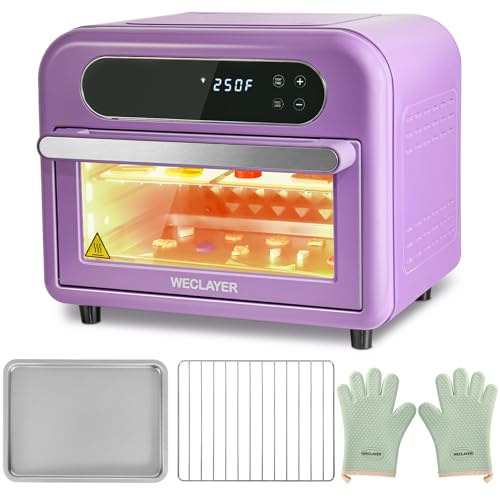
- 13-quart capacity
- Digital time and temperature controls
- Includes tray, rack, and gloves
Best For: Digitally controlled small to medium batches
Large-Batch Pick

- Roomy 38-quart capacity
- Fan and six heating tubes
- Includes rack and gloves
Best For: Larger pieces and frequent batch baking
Best Equipped Kit – 25QT Polymer Clay Oven
If you need a clay oven for baking multiple polymer clay pieces, this 25-quart model pairs two-shelf capacity with a useful starter kit. Its adjustable dial covers 0–450°F, and the included thermometer lets you check the actual oven temperature before loading your work.
Best For: Makers who want room for batches and baking accessories in one purchase.
Pros:
- 25-quart capacity accommodates two layers of smaller pieces.
- Includes a tray, grid, rack, thermometer, silicone mats, and gloves.
- Timer runs up to 60 minutes, with a stay-on setting.
Cons:
- Mechanical dial readings may differ from the internal temperature; use the included thermometer.
- Taller pieces may need a single-shelf setup.
The accessories make this a practical choice for repeat batches, while the thermometer is especially useful for checking that the oven has reached your clay brand’s specified curing temperature.
Compact Craft Pick – AMACO Countertop Craft/Clay Oven
For small polymer clay projects, this AMACO clay oven for baking offers a dedicated countertop option with a 540-cubic-inch interior. It heats craft products up to 300°F and has a built-in 30-minute timer.
Best For: Crafters baking smaller pieces who prefer a compact, dedicated oven.
Pros:
- Interior measures 11 inches wide by 5 inches high by 7.5 inches deep.
- Heats polymer clay and other craft products requiring up to 300°F.
- Includes a 30-minute timer.
Cons:
- Limited interior height may restrict taller projects.
- 30-minute timer may require resetting for longer baking schedules.
This is a straightforward option if your work fits its interior. Check your clay’s required temperature and curing time against its 300°F limit and 30-minute timer before buying.
Digital Compact Pick – 13QT Polymer Clay Oven
This 13-quart clay oven for baking polymer clay combines a digital touch screen with fast preheating in a smaller-capacity unit. Its top fan, four heating tubes, and circulating hot air are designed to distribute heat across batches.
Best For: Makers who want digital controls for small to medium polymer clay batches.
Pros:
- Touch screen provides time and temperature controls.
- Fan-assisted hot-air circulation and four heating tubes support even heating.
- Includes a baking tray, wire rack, and gloves.
Cons:
- 13-quart capacity leaves less room for large pieces than higher-capacity models.
- Product details list one shelf, despite the description’s two-layer baking claim; verify the usable configuration for your projects.
Choose this model if you value a digital interface and quicker preheating more than maximum interior space. Follow your clay maker’s temperature instructions and allow the display to stabilize before baking.
Large-Batch Pick – 38QT Polymer Clay Oven
For makers needing more space, this 38-quart clay oven for baking polymer clay is sized for batches or taller work. It pairs fast preheating with a top fan, six heating tubes, and circulating hot air.
Best For: Frequent batch baking or larger polymer clay pieces that need a roomy oven.
Pros:
- 38-quart capacity provides space for larger projects and batches.
- Six heating tubes and circulating hot air are designed for even heating.
- Includes a wire rack and thickened gloves.
Cons:
- For taller pieces, the maker recommends using only one layer.
- Supplied details conflict on controls: the description says digital touch screen, while the specifications say knob control.
Its main advantage is capacity, but confirm the control layout before ordering if a digital interface matters to you. As with any polymer clay oven, use the time and temperature specified for your clay.
How We Picked the Best Clay Oven for Baking
We focused on the four selected countertop options and compared their stated capacity, temperature and time controls, included accessories, and electrical requirements where specified. Those details matter because polymer clay needs a controlled bake, enough space around each piece, and a setup that fits your work area. We did not treat advertised preheat or precision claims as independently verified performance.
Quick Comparison
The AMACO Countertop Craft/Clay Oven is the compact option, with listed dimensions of 15 x 7 x 8 inches. The 12L/13QT oven is a small-capacity electric model rated at 120V and 1200W, with advertised fast preheat and precise temperature and time settings. The 25QT model offers more room, adjustable time and temperature, and an included tray and wire rack. The 36L/38QT oven has the largest stated capacity here; it is rated at 120V and 1800W and advertises fast preheat and precise controls. Capacities are not interchangeable with usable baking dimensions, so check interior measurements before ordering.
Key Buying Factors for a Clay Oven for Baking
Temperature Control and Verification
Follow the temperature and duration on your clay package, not a universal setting. An oven thermometer can help you check the temperature where your work sits, especially during initial test bakes. A clear timer is useful, but it does not replace checking that the oven reaches and holds the setting you need.
Usable Space and Batch Size
Measure your tallest piece and the footprint of your baking surface, then allow room for safe placement and airflow according to the oven’s instructions. Larger stated capacity may help with batch baking, but it also takes more counter and storage space. If you bake only a few small pieces at once, extra volume may offer little practical benefit.
Power, Placement, and Accessories
Confirm that your outlet and circuit can accommodate the oven’s stated electrical rating; the 12L and 36L models list 1200W and 1800W, respectively. Leave the manufacturer-required clearance around the oven and use a stable, heat-safe surface. Check whether a suitable tray or rack is supplied: the 25QT listing includes both, while accessories for the other options should be confirmed before purchase.
Who Should Buy Which Clay Oven for Baking?
Choose the AMACO model if a compact countertop footprint is your priority and its interior fits your projects. Consider the 12L model for smaller batches when you want a stated 120V/1200W rating. The 25QT model is a middle-ground choice if you need more room and value the included tray and rack. Pick the 36L model for larger pieces or batch layouts, provided you have the space and an appropriate electrical setup. Whichever Clay Oven for Baking you choose, verify usable dimensions and test its temperature before committing important work.
