Shopping for a double arm dough mixer? The terminology matters: the 10 machines in this roundup are primarily commercial spiral mixers advertised with dual-action or double-speed operation, not necessarily true two-arm kneaders.
Use this guide to match batch size, mixing action, and electrical requirements to your kitchen—and to spot the specifications worth confirming before you order.
Best 10 Double Arm Dough Mixer Picks for 2026
Best for Easy Dough Removal

- 30-quart bowl
- 90° tilting bowl
- Forward and reverse rotation
Best For: Large batches with easier dough unloading
Best for High-Volume Mixing

- 50-liter capacity
- Up to 40 lb dry flour
- Two speeds and rotating bowl
Best For: High-volume commercial dough preparation
Best for Two-Speed Kneading

- 30-quart bowl
- Two-speed double action
- 304 stainless food-contact parts
Best For: Two-speed bread and pizza dough mixing
Best for Timed Small Batches
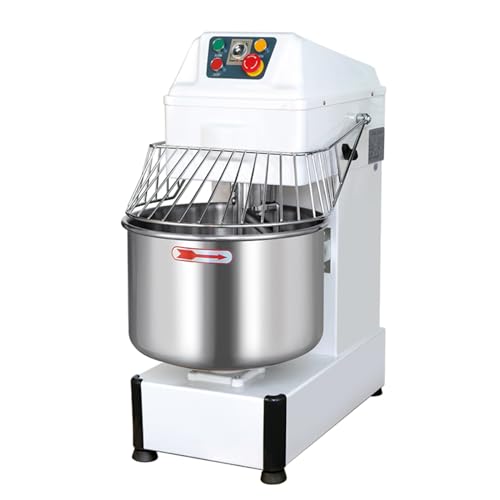
- 20-liter bowl
- Up to 8 kg of dough
- 1–30 minute timer
Best For: Timed, moderate-sized commercial dough batches
Best 30-Quart Option

- 30-quart stainless steel bowl
- Two speeds; rotating bowl and spiral head
- Tilting bowl and cover shutoff
Best For: Commercial kitchens making medium-to-large dough batches
Largest Capacity

- Largest listed bowl here at 50L
- Slow, fast, and timed automatic modes
- Cover shutoff plus emergency stop
Best For: High-volume kitchens needing timed kneading cycles
Best Preset Cycle
TECHTONGDA 40L Double-Action Mixer
- 40L stainless steel capacity
- Preset three-minute slow, eight-minute fast cycle
- Cover shutoff; hold-to-run reverse mode
Best For: Commercial kitchens wanting a preset two-speed cycle
Best with Extra Features

- 30L bowl; up to 12kg dry flour
- Two speeds, timer, and reverse button
- Fixed bowl; 230-pound machine
Best For: Large commercial batches where reverse-assisted dough removal is useful
Best for Programmed Mixing

- 30L bowl; up to 12kg dry flour
- Timed automatic speed sequences
- Gearbox speed changes; fixed bowl
Best For: Commercial kitchens using timed, repeatable mixing routines
Best for Smaller Commercial Batches
15L Variable-Speed Spiral Mixer

- 15L bowl; up to 5kg dry flour
- Adjustable 153–268 RPM speed
- Digital timing and rotation controls
Best For: Smaller commercial batches needing adjustable speed
Best for Easy Dough Removal – 30Qt Tilting-Bowl Flour Mixer
This 30-quart double arm dough mixer option is built for larger batches, with an 800W motor, double-gear drive, and a bowl that tilts 90° for unloading. Its forward and reverse rotation settings offer separate modes for mixing dough and helping remove it.
Best For: Bakeries and pizzerias that want a large bowl with easier access for dough removal and cleaning.
Pros:
- 30-quart bowl reduces the need to split larger jobs into multiple batches.
- 90° tilt and reverse rotation help with unloading.
- Polished stainless steel bowl surface can be wiped clean after use.
Cons:
- At 109.3 pounds, it is not a convenient machine to move frequently.
- Listed noise level is 85 dB.
Choose this model for bowl access and batch capacity rather than speed flexibility: its notes describe a 40 rpm mixing rod but do not list multiple mixing speeds.
Best for High-Volume Mixing – INTSUPERMAI 50L Spiral Mixer
For kitchens comparing double arm dough mixer options, this 50-liter INTSUPERMAI uses double-action spiral mixing: the hook and bowl rotate together. Its two speeds let operators adjust mixing for different dough consistencies, and the stated maximum is 40 pounds of dry flour per batch.
Best For: Commercial kitchens that need high flour capacity and a choice of two mixing speeds.
Pros:
- Handles up to 40 pounds of dry flour at once, according to the listing.
- Two-speed gearbox drives simultaneous spiral-hook and bowl rotation.
- Protective cover cuts power when opened; an emergency stop switch is also included.
Cons:
- The bowl cannot be removed, which limits access for cleaning and unloading.
- At 30.31 by 13.98 by 35.43 inches, it requires dedicated floor or work space.
This is the capacity-focused choice in the group. Before buying, make sure a fixed bowl suits your workflow.
Best for Two-Speed Kneading – INTBUYING 30Qt Spiral Mixer
This INTBUYING double arm dough mixer alternative combines a 30-quart bowl with a spiral hook and bowl that rotate simultaneously. A 1500W copper motor and two mixing speeds make it a practical candidate for commercial bread and pizza dough production.
Best For: Bakeries and pizzerias seeking a 30-quart, two-speed spiral mixer with stainless steel food-contact parts.
Pros:
- Double-action mixing pairs rotating hook and bowl for even kneading.
- Fast and slow settings offer flexibility across dough recipes.
- Food-contact parts are listed as 304 stainless steel.
- Opening the protective cover automatically cuts power.
Cons:
- Its 34.64-inch height needs clearance in the kitchen.
- No flour-per-batch limit is specified in the supplied notes, so bowl volume alone should not determine batch size.
It offers a useful balance of capacity and speed control, but confirm that your intended flour load fits the machine’s operating limits before planning production around it.
Best for Timed Small Batches – INTSUPERMAI 20L Spiral Mixer
If you are shopping for a double arm dough mixer but need a smaller commercial batch size, this INTSUPERMAI model offers a 20-liter bowl and a stated capacity of 8 kg of dough. Its spiral hook and bowl rotate together, with two speeds and a 1–30 minute timer.
Best For: Commercial kitchens that want timed kneading for batches of up to 8 kg of dough.
Pros:
- Two mixing speeds let operators choose between slower and faster kneading.
- 1–30 minute timer supports repeatable mixing sessions.
- Protective cover shuts the machine off when lifted; a stop button is also provided.
Cons:
- The bowl is not removable.
- Listed weight is 90 kg, making frequent repositioning impractical.
Its timer distinguishes it from the larger models here. The fixed bowl and 8 kg stated dough limit make it better suited to planned, moderate-sized batches than maximum-volume production.
Best 30-Quart Option – 30QT Dual-Action Spiral Mixer
If you need a commercial double arm dough mixer for sizable batches, this 30-quart model offers simultaneous spiral-head and bowl rotation with fast and slow settings. Its 1500W motor and food-contact parts made from 304 stainless steel suit regular bakery or pizzeria use.
Best For: Commercial kitchens that want a 30-quart mixer for pizza, bread, or pastry dough.
Pros:
- Rotating bowl and spiral head promote uniform kneading.
- Fast and slow settings accommodate different dough consistencies.
- Protective-cover shutoff and tilting bowl add practical safety and access.
Cons:
- At 206 pounds, it is not easy to move between workstations.
- Its 30-quart capacity is smaller than the 40L and 50L options here.
Choose this model when 30 quarts is enough and a tilting bowl matters more to your workflow than maximum batch capacity. The supplied specifications describe dual-action spiral mixing, not two separate kneading arms.
Largest Capacity – 50L Timed Double-Action Mixer
For buyers comparing commercial double arm dough mixer options by batch size, this 50L machine has the largest stated capacity in this group. Its stirring rod and bowl rotate together, with slow, fast, and automatic modes for managing a kneading cycle.
Best For: Bakeries and commercial kitchens prioritizing 50L capacity and timed speed changes.
Pros:
- 50L bowl provides room for large commercial batches.
- Automatic mode lets you set slow- and fast-running times before the machine stops.
- Protective-cover shutoff and an emergency-stop switch provide two safety controls.
Cons:
- Its listed 34.65-inch width calls for substantial floor space.
- The supplied information does not state its operating voltage; confirm compatibility before purchasing.
This is the capacity-first pick if your workspace can accommodate it. Despite the search term, the supplied description specifies a rotating stirring rod and bowl rather than two separate dough arms.
Best Preset Cycle – TECHTONGDA 40L Double-Action Mixer
This 40L TECHTONGDA model is worth considering when a double arm dough mixer search leads you to commercial double-action machines. Its bowl and stir bar rotate simultaneously, and its preset cycle runs slowly for three minutes, then quickly for eight minutes before stopping.
Best For: Bakeries and pizzerias that want a 40L machine with an automatic slow-to-fast cycle.
Pros:
- 40L capacity and 304 stainless steel construction suit substantial dough batches.
- Automatic cycle switches speeds and stops without a manual changeover.
- Protective-cover shutoff adds a safety measure during operation.
Cons:
- At 279 pounds, it requires a planned installation spot.
- Reverse mode must be held down continuously to operate.
The preset cycle is its clearest advantage if that timing fits your dough process. Its supplied specifications describe double-action bowl-and-stir-bar mixing, not a pair of kneading arms.
Best with Extra Features – INTSUPERMAI 30L Spiral Mixer
If you’re searching for a double arm dough mixer, note that this is a double-action spiral model: its bowl and hook rotate together. The 30L capacity and 12kg maximum dry-flour load make it a commercial-scale option for bakeries and pizzerias.
Best For: Commercial kitchens that need large batches and a reverse function to help release finished dough.
Pros:
- Two mixing speeds, listed at 168 and 252 RPM, plus a timer with automatic stop.
- Reverse button helps remove dough after mixing.
- Food-contact parts are #304 stainless steel; opening the cover cuts power, and an emergency-stop switch is included.
Cons:
- The bowl is not removable, which may complicate cleanup.
- At 230 pounds, it needs a dedicated location rather than frequent repositioning.
Choose this model if the reverse control matters to your workflow. Its fixed bowl is the main trade-off to weigh against its batch capacity.
Best for Programmed Mixing – INTSUPERMA 30L Spiral Mixer
This commercial option for shoppers comparing a double arm dough mixer uses double-action spiral mixing: the bowl and spiral head turn together. Its 30L bowl and 12kg maximum dry-flour capacity suit substantial dough batches.
Best For: Bakeries and pizzerias that want timed, selectable speed sequences for repeatable mixing routines.
Pros:
- Choose fast or slow speeds, or use automatic modes with different speed processes and a settable timer.
- Gearbox speed changing is designed to avoid the slipping associated with belt-pulley speed changes.
- #304 stainless-steel food-contact parts, a cover interlock, and an emergency-stop switch are included.
Cons:
- The bowl cannot be removed.
- Its 230-pound weight and roughly 28-inch depth call for planned placement.
The programmable controls distinguish this model from a basic two-speed mixer. Check that a fixed-bowl cleaning routine fits your kitchen before committing.
Best for Smaller Commercial Batches – 15L Variable-Speed Spiral Mixer
If you’re considering a double arm dough mixer for smaller batches, this 15L machine is instead a double-action spiral mixer with a rotating bowl and hook. Its stated limit is 5kg of dry flour, making it the lower-capacity choice in this group.
Best For: Bakeries or pizzerias that need smaller commercial batches with adjustable mixing settings.
Pros:
- Continuously adjustable speed is listed at 153–268 RPM.
- Digital controls let you set speed, duration, and rotation mode independently.
- Stainless-steel bowl and hook, a clear protective cover, and a cover-open safety interlock are included.
Cons:
- The 5kg dry-flour limit is less than half that of the two 30L models above.
- The supplied notes do not establish that this is a traditional two-arm mixer.
Its appeal is control over smaller runs, not maximum throughput. If a true twin-arm kneading mechanism is essential, confirm the machine type before buying.
How We Picked the Best Double Arm Dough Mixer
We compared the supplied product listings for bowl capacity, advertised mixing action, speed options, power requirements, and features such as timers and tilting bowls. The list spans roughly 15 to 50 quarts, giving small kitchens and higher-volume operations different starting points. These are listing-based comparisons, not hands-on performance tests; verify specifications and included accessories with the seller before purchase.
One distinction is essential: a true Double Arm Dough Mixer uses two kneading arms. Many products here instead describe a rotating spiral hook and bowl as “double action,” or use “double speed” to describe selectable settings. Neither phrase guarantees a two-arm kneading mechanism.
Quick Comparison by Kitchen Need
Capacity and Workflow
The 15-quart listing is the compact option; the approximately 20- to 21-quart listings sit in the middle; and several 30-quart listings target larger batches. The 40-liter TECHTONGDA and 50-quart model suit buyers seeking more stated bowl volume. A larger bowl is not automatically better: ask for minimum and maximum dough batch weights so your everyday recipe falls within the machine’s effective mixing range.
Features to Check
The listings include dual-action spiral designs, two-speed or variable-speed claims, a timer-equipped TECHTONGDA model, and a 30-quart model advertising a tilting bowl. Compare those features against how you actually load ingredients, monitor mixing, and remove finished dough. Confirm whether controls and bowl movement work as described in the current listing.
Key Buying Factors for a Double Arm Dough Mixer
Mixing mechanism: If your recipe or production process specifically calls for a Double Arm Dough Mixer, request photos or a diagram of the mixing chamber. Do not substitute a spiral mixer based solely on “double action” in the product name.
Usable batch size: Bowl volume does not equal dough capacity. Request rated dough weight, flour capacity, and any hydration limits. Check the minimum batch size, too—an oversized mixer may struggle to engage small batches consistently.
Electrical and operating needs: Check voltage, amperage, plug type, and circuit requirements against your site. Wattage alone cannot establish kneading strength or suitability for stiff dough. Also confirm the machine’s footprint, weight, clearance, cleaning access, safety guard, and parts availability.
Documentation: Similar-sounding 30 L and 30 QT listings are not identical capacity claims. Ask sellers to confirm the exact model, bowl size, speed settings, warranty terms, and service support before committing.
Who Should Buy Which Double Arm Dough Mixer?
Choose a smaller 15- to 21-quart listing if your documented batch weights fit and floor space is limited. Start with the 30-quart group if you need a broader midrange selection, then narrow it by verified dough capacity and workflow features. Consider the 40-liter or 50-quart listings for larger batches only if your recipes and electrical setup support them. If two kneading arms are nonnegotiable, look beyond these spiral-mixer listings until a seller confirms the actual mechanism.
