Making empanadas at scale takes more than a good recipe. The right press can help your team portion, fold, and seal more consistently—but a compact mold and an automatic production machine solve very different problems.
These five options span smaller-batch presses and higher-output equipment. Use the buying guide below to match a machine to your dough, empanada size, staffing, and daily volume.
Best 5 Empanada Press Machine Commercial Picks for 2026
High-Volume Pick
Automatic Empanada Maker with 14 × 7 cm Mold

- Listed capacity: up to 6,800 pieces/hour
- Includes one 14 × 7 cm empanada mold
- 110V; approximately 220.5 pounds
Best For: High-volume production using a specified empanada mold size
Manual Pick

- Manual closing and stamping
- Listed output: 100 empanadas/hour
- For 5-inch wheat-flour empanadas
Best For: Smaller batches of 5-inch wheat-flour empanadas
Multi-Shape Option
Automatic Maker with Empanada Mold

- Listed capacity: up to 6,800 pieces/hour
- Includes one empanada mold
- 48 other mold shapes listed as optional
Best For: High-volume operations considering additional product shapes
Small-Batch Electric Pick
FineMade 4-Slot Empanada Maker
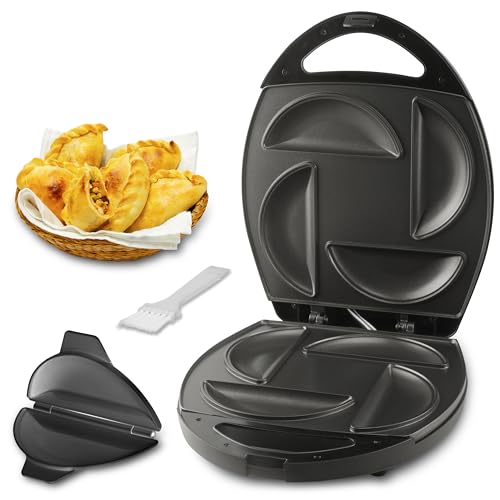
- Four 6-inch empanadas per batch
- Included dough-sizing press mold
- Adjustable temperature and nonstick plates
Best For: Home cooks preparing small batches
High-Volume Automatic Pick
Koalalko Commercial Dumpling Machine

- Listed at roughly 4,800–5,000 pieces/hour
- Adjustable dough thickness and filling
- One mold included; other shapes sold separately
Best For: High-volume food-production operations
High-Volume Pick – Automatic Empanada Maker with 14 × 7 cm Mold
For buyers comparing an empanada press machine commercial kitchens can use for high-volume production, this automatic stainless steel model lists a capacity of up to 6,800 pieces per hour. It includes one 14 × 7 cm empanada mold and runs on 110V power.
Best For: Production facilities that need automated output and the specified empanada mold size.
Pros:
- Adjustable speed and dough thickness offer production control.
- Double-spiral mixing and automatic powder spreading support the workflow.
- Lists 48 optional mold shapes for other products.
Cons:
- At about 220.5 pounds and 37 × 18.9 × 39.37 inches, it requires substantial space and handling.
- Only one mold is listed as included; other shapes are optional.
Check that the included 14 × 7 cm mold fits your menu before buying. The listed capacity makes this a production-focused choice, not a compact countertop press.
Manual Pick – EMPAMEC 5-Inch Empanada Maker
If your search for an empanada press machine commercial kitchens can use does not require automation, the manual EMPAMEC offers a smaller-footprint option. It is specified for wheat-flour dough, makes 5-inch (13 cm) empanadas, and lists output of 100 per hour.
Best For: Smaller-batch operations making 5-inch empanadas with wheat-flour dough.
Pros:
- Manual operation requires no listed electrical setup.
- Includes the body and mold for closing and stamping empanadas.
- 8 × 7.5 × 3-inch body is compact compared with the automatic models here.
Cons:
- Listed output of 100 per hour is far below the automatic models’ stated capacity.
- Specified for wheat-flour dough and a 5-inch diameter.
This is the practical choice when a consistent 5-inch format matters more than automated throughput. Confirm your dough and target size match its specifications.
Multi-Shape Option – Automatic Maker with Empanada Mold
This empanada press machine commercial operators may consider for a varied menu includes one empanada mold and lists 48 optional mold shapes. The automatic stainless steel machine is rated for up to 6,800 pieces per hour and uses 110V power.
Best For: High-volume kitchens planning to make empanadas and potentially add other mold shapes.
Pros:
- Adjustable speed and dough thickness support different production settings.
- Independent filling switch and automatic powder spreading add workflow controls.
- Optional molds cover additional shapes beyond the included empanada mold.
Cons:
- Optional shapes are not listed as included.
- At about 220.5 pounds and 37 × 18.9 × 39.37 inches, it needs dedicated space.
The included empanada mold makes it ready for that format, while the optional molds provide a route to expand. Verify the mold size you need, since the supplied notes do not specify its dimensions.
Small-Batch Electric Pick – FineMade 4-Slot Empanada Maker
If your search for an empanada press machine commercial option leads you to smaller-batch equipment, this FineMade maker is worth a look. It bakes four 6-inch empanadas per batch and includes a press mold to size and cut the dough for its cooking plates.
Best For: Home cooks making several large empanadas at a time.
Pros:
- Bakes four empanadas per batch, with a stated cooking time of 15 minutes.
- Temperature dial lets you adjust between warming and baking.
- Nonstick plates simplify cleanup; the included mold helps prepare the dough.
Cons:
- Four-piece batch capacity is limited for high-volume service.
- Despite the search term, the product notes describe it as suited to family use, not commercial production.
Choose this 1000W countertop maker when consistent sizing and easy batch cooking matter more than production-scale output.
High-Volume Automatic Pick – Koalalko Commercial Dumpling Machine
For buyers who need an empanada press machine commercial setup with automated forming, this Koalalko machine is the higher-volume choice. Its dough-rolling, filling, wrapper-making, and forming systems work together, with adjustable wrapper thickness and filling quantity.
Best For: Food-production operations equipped to accommodate a large automatic machine.
Pros:
- Listing describes output of roughly 4,800–5,000 pieces per hour.
- Adjustable wrapper thickness and filling quantity support different products.
- Includes one mold; additional shapes are offered separately.
Cons:
- At 220 pounds and 25.19 by 17.32 by 31.49 inches, it requires substantial space and handling.
- Only one mold is included, so other shapes require an additional purchase.
- The stated output differs between the title and product notes; confirm the applicable rate before buying.
This is the more appropriate option for automated, high-volume work, provided its included mold matches the product you intend to make.
How We Picked the Best Empanada Press Machine Commercial
We compared the selected machines as different ways to speed up empanada production, rather than treating every mold as a substitute for an automated line. The main considerations were stated output, finished size, how much work an operator still has to do, and whether a listing gives enough detail to plan a commercial workflow. Published capacities are useful starting points, not guarantees: dough consistency, filling, operator experience, and cleaning time affect real-world throughput.
Quick Comparison: Match the Machine to Your Volume
For smaller batches, a mold-style commercial empanada press machine can be a practical way to improve shape and sealing without committing to large equipment. The Commercial Empanada Mold and the dumpling/gyoza/ravioli maker are worth comparing on cavity dimensions and the steps each requires.
The EMPAMEC maker specifies a 5-inch (13 cm) dough diameter and wheat-flour dough, making it a more defined choice if those match your recipe. FineMade’s electric model is listed as making four large, 6-inch pieces per cycle; check whether that size and batch format suit your menu. At the other end, the automatic dumpling and empanada machine advertises up to 4,800 pieces per hour. Treat that as a manufacturer-stated rate and confirm output with your dough, filling, and included mold before planning production around it.
Key Buying Factors for an Empanada Press Machine Commercial Kitchen
Finished Size and Dough Compatibility
Start with the empanada you sell. Confirm whether a stated measurement refers to the dough round, mold cavity, or finished piece, and ask about filling capacity if portions matter. A machine designed around wheat-flour dough may not handle a different formula equally well.
Throughput and Labor
Count every step: cutting dough, adding filling, pressing, removing pieces, and resetting the machine. An electric press may reduce repetitive handwork while still requiring an operator for each cycle. An automatic machine may offer far higher output but need more setup, feeding, adjustment, and cleaning.
Fit, Cleaning, and Support
Check countertop or floor space, electrical requirements, and whether food-contact parts can be removed for thorough cleaning. For equipment that your business will depend on daily, verify access to replacement molds, consumable parts, instructions, and service before ordering.
Who Should Buy Which Empanada Press Machine Commercial?
Choose a compact mold-style option if you are testing a menu, handling modest volume, or want to standardize hand-assembled empanadas. Consider the EMPAMEC model if its specified 5-inch wheat-dough format is already close to your recipe. The FineMade electric maker is better suited to buyers who want larger pieces made in small repeated batches. Consider the advertised 4,800-piece-per-hour automatic machine only when demand, space, and staffing justify a production-focused setup—and get written confirmation of its specifications first.
