The best food mills for home use make smooth sauces, mashed potatoes, baby food, and fruit purees without peeling and hand-mashing every ingredient. The right model can also simplify tomato processing, applesauce, jams, and small-batch canning.
This roundup compares 10 options across capacity, disc selection, construction, and operating style so you can choose a mill that fits your kitchen routine rather than paying for features you will not use.
Best 10 Food Mills for Home Use Picks for 2026
Best Overall

- Stainless steel bowl suits hot foods
- Three discs provide varied textures
- Folding legs simplify storage
Best For: Everyday purees and sauces
Most Versatile Manual Grinder
Hand-Crank Meat and Vegetable Grinder

- No outlet required for operation
- Grinds meat and fills sausages
- Also processes sauces and vegetables
Best For: Manual meat and multipurpose food prep
Best for Canning
Hungry Artisan 3-Disc Food Mill

- Separates skins, seeds, and cores
- Three discs cover multiple textures
- Works anywhere without an outlet
Best For: Applesauce, tomato sauce, and canning
Best for Large Meat Batches

- Electric motor speeds up grinding
- Three plates offer different grind sizes
- Includes three sausage-stuffer tubes
Best For: Bulk meat grinding and sausage making
Most Versatile
4-Disc Stainless Steel Food Mill

- Four interchangeable discs for flexible textures
- Comfortable crank and secure support hooks
- Dishwasher-safe stainless steel construction
Best For: Home cooks who want maximum texture control for sauces, purees, and preserving
Best for Large Batches

- Generous 3.5-quart capacity
- Suitable for mashing, straining, grating, and ricing
- Durable stainless steel finish
Best For: Cooks processing larger batches of fruits, vegetables, sauces, and purees
Best Value Features

- Coarse, medium, and fine interchangeable discs
- Dual hooks and silicone-covered crank
- Dishwasher-safe stainless steel construction
Best For: Everyday sauces, jams, purees, and canning with three texture choices
Best Electric Dry Grinder
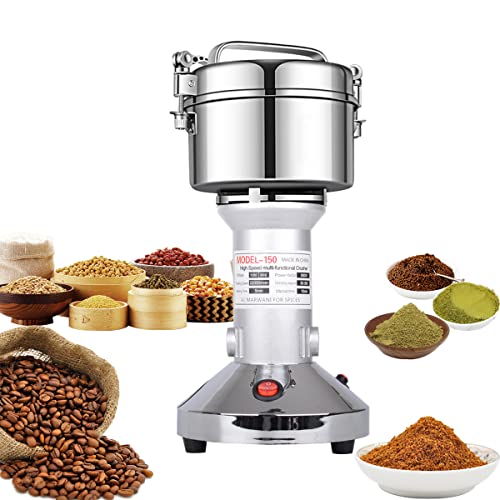
- 900W motor for quick dry grinding
- Handles grains, spices, herbs, and nuts
- Overload protection and locking lid
Best For: Small batches of dry ingredients
Best Accessory-Rich Mill
Stainless Steel Food Mill with Spoon

- Three milling discs for varied textures
- Dual-hook stability design
- Includes spoon, funnel, and measuring spoon
Best For: Manual sauce, potato, jam, and canning preparation
Best Overall – OXO Stainless Steel Food Mill
For home cooks comparing food mills for home use, the OXO Good Grips model is a versatile choice for preparing hot purees, sauces, and other foods. Its stainless steel bowl resists staining, while three interchangeable discs provide fine, medium, or coarse textures.
Best For: Home cooks who want a durable, easy-to-store mill for purees and sauces.
Pros:
- Stainless steel bowl is suitable for hot foods and helps prevent staining.
- Three stainless steel discs accommodate fine, medium, and coarse textures.
- Non-slip legs fit bowls and pots up to 11 inches in diameter.
- Spring-loaded lever simplifies disc changes, and folding legs aid storage.
Cons:
- Its approximately 2.3-quart capacity may be limiting for very large batches.
- At about 1 kilogram, it is less lightweight than a compact plastic mill.
With a stable design, useful texture range, and hot-food-friendly stainless steel construction, this is a well-rounded option for everyday kitchen prep.
Most Versatile Manual Grinder – Hand-Crank Meat and Vegetable Grinder
Although designed primarily as a meat grinder, this manual model may appeal to shoppers seeking food mills for home use with broader food-processing abilities. It handles meat, sausage filling, chili sauce, peanut butter, garlic paste, and vegetables without requiring an electrical outlet.
Best For: Households wanting a manual grinder for meats, sausage making, and selected sauces or vegetable preparations.
Pros:
- Manual operation works without a power cord.
- Two-in-one design grinds meat and fills sausages.
- Aluminum alloy construction is described as durable and rust-resistant.
- Parts disassemble without tools for cleaning and compact storage.
Cons:
- It is a meat grinder rather than a dedicated disc-style food mill.
- Manual cranking requires more hands-on effort than an electric appliance.
- The supplied notes do not specify interchangeable puree-texture discs.
This is a practical specialty pick for cooks who prioritize manual meat processing and multifunction use over traditional fruit-and-vegetable milling.
Best for Canning – Hungry Artisan 3-Disc Food Mill
For canning projects and seasonal produce, the Hungry Artisan is a focused option among food mills for home use. Its hand crank separates applesauce from skins, seeds, and cores, while three stainless steel discs let you choose a chunky, medium, or smooth result.
Best For: Home canners making applesauce, tomato sauce, purees, and similar batch recipes.
Pros:
- Separates applesauce from skins, seeds, and cores during cranking.
- Three stainless steel discs provide coarse, medium, and fine textures.
- Manual operation allows setup anywhere without an outlet.
- Stainless steel body, discs, and crank are designed for repeated use.
Cons:
- The 2.8-pound construction may feel bulky for occasional light use.
- Its listed dimensions require more storage space than a very compact mill.
- As a hand-crank model, it requires continuous manual effort.
Its straightforward separation process and three texture settings make it especially useful for preserving fruit and turning garden produce into sauces.
Best for Large Meat Batches – Aiheal Electric Meat Grinder
Shoppers considering food mills for home use should note that this Aiheal appliance is an electric meat grinder, not a traditional puree mill. It is built for faster bulk meat processing, with three grinding plates, two blades, and three sausage-stuffer tubes for varied kitchen tasks.
Best For: Home kitchens processing larger quantities of meat or making sausages and ground-meat recipes.
Pros:
- 300-watt motor with 3,200-watt maximum locked power is designed for faster grinding.
- Three plates support 2 mm, 5 mm, and 7 mm grinding sizes.
- Three sausage tubes expand its use beyond basic mincing.
- Locking and overload protection add safety features during operation.
Cons:
- It is intended for mincing and sausage making rather than pureeing produce.
- Removable parts should not be placed in the dishwasher.
- Its electric motor requires counter space and access to power.
If your priority is efficient meat preparation rather than smooth fruit or vegetable purees, this stainless steel grinder offers more speed and capacity-oriented functionality than a conventional food mill.
Most Versatile – 4-Disc Stainless Steel Food Mill
For home cooks comparing food mills for home use, this Hungry Artisan model stands out for its four interchangeable stainless steel discs. It is designed for fine, coarse, and ultra-fine textures, making it useful for sauces, purees, applesauce, mashed potatoes, jams, baby food, and preserving.
Best For: Home cooks who want broad texture control and a sturdy manual mill for regular cooking, canning, or large-batch seasonal prep.
Pros:
- Four discs provide fine, coarse, and ultra-fine texture options.
- Stainless steel construction resists rust, corrosion, and wear.
- Silicone-grip crank, spring-loaded design, and double-welded hooks support comfortable, stable use.
- Dishwasher-safe construction makes cleanup easier.
Cons:
- A four-disc setup may be more than needed for cooks who only make one type of puree.
- Capacity and dimensions should be checked to ensure a good fit with your bowls and pots.
This is the most feature-rich option of the three, especially if you value precise texture adjustment and intend to use a food mill for both everyday recipes and preserving projects.
Best for Large Batches – Mirro 3.5-Quart Food Mill
Mirro 50025 Foley Stainless Steel Healthy Food Mill Cookware, 3.5-Quart, Silver -
Check Price On AmazonIf capacity is a priority when choosing food mills for home use, the Mirro Foley offers a generous 3.5-quart size. Its stainless steel design is intended for processing larger batches of tomatoes, apples, potatoes, fruits, and vegetables into sauces and purees.
Best For: Home cooks who prepare sizable batches of sauces, purees, or mashed foods and want a straightforward, generously sized mill.
Pros:
- 3.5-quart capacity is suited to larger food-preparation jobs.
- Designed for mashing, straining, grating, and ricing.
- Stainless steel finish supports durability and easier cleaning.
Cons:
- The supplied details do not specify interchangeable discs or multiple texture settings.
- Its larger dimensions may be less convenient for smaller kitchens or limited storage.
The Mirro is a practical capacity-focused choice. It makes the most sense for cooks who prefer handling more ingredients at once rather than prioritizing a wide range of milling textures.
Best Value Features – 3-Disc Tomato and Jam Mill
This three-disc stainless steel model is a practical option for shoppers seeking food mills for home use with adjustable textures. Coarse, medium, and fine discs cover common tasks such as tomato sauce, jam, mashed potatoes, applesauce, purees, and canning.
Best For: Home cooks who want three useful texture settings, comfortable handling, and easy cleanup for everyday meal prep.
Pros:
- Three interchangeable discs offer coarse, medium, and fine results.
- Dual hooks help secure the mill over deep or shallow pots and bowls.
- Silicone-covered crank handle is designed for a more comfortable grip.
- Dishwasher-safe, corrosion-resistant steel is easy to clean and store.
Cons:
- It offers one fewer disc than the four-disc Hungry Artisan model.
- The supplied details do not state the mill’s capacity.
With useful texture coverage and a space-saving hanging hole, this model balances versatility and convenience. It is a strong fit when you want a manual mill for common sauces, preserves, and purees without needing four texture options.
Best Manual Stainless Steel Pick – 2-Quart Rotary Food Mill
For shoppers comparing food mills for home use, this 2-quart stainless steel model offers straightforward manual processing for soft fruits and vegetables. Its three interchangeable discs let you choose fine, medium, or coarse textures for sauces, soups, applesauce, baby food, and mashed potatoes.
Best For: Home cooks who want a durable manual mill with multiple texture options.
Pros:
- Food-grade stainless steel construction with a dishwasher-safe surface.
- Three discs support fine, medium, and coarse results.
- Two anti-slip handles and a rounded crank grip help with control.
Cons:
- Requires manual cranking rather than electric operation.
- Must be assembled manually before use.
With its 2-quart capacity and traditional hand-crank design, this mill is a practical choice for routine sauces, purées, and mashed foods. The interchangeable discs add flexibility without requiring a powered appliance.
Best Electric Dry Grinder – 150g High-Speed Grain Mill
Among food mills for home use, this compact electric grinder is aimed at turning dry grains, spices, herbs, seeds, and nuts into powder. Its 900W motor and 150g capacity are suited to quick small-batch grinding, but the operating limits require careful use.
Best For: Small-batch grinding of dry grains, spices, herbs, and similar ingredients.
Pros:
- 900W motor and high-speed operation for rapid dry grinding.
- Supports grains, spices, herbs, seeds, nuts, and coffee beans.
- Overload protection and a snap-on lid with a locking design.
Cons:
- Not suitable for wet, moist, or oily ingredients.
- Operation should be limited to three minutes, followed by a 5–10-minute rest.
- The grinding chamber should not be rinsed directly with water.
This grinder is more appropriate for dry pantry ingredients than for cooked foods or soft produce. Its compact capacity and maintenance requirements make it best for users comfortable with short grinding cycles and cloth-based cleanup.
Best Accessory-Rich Mill – Stainless Steel Food Mill with Spoon
This stainless steel option is a versatile choice for food mills for home use, combining three milling discs with a stabilizing dual-hook design. It is built for tomato sauce, potatoes, jams, fruits, and vegetables, and includes a spoon, funnel, and measuring spoon for added kitchen convenience.
Best For: Home cooks who want a stable manual mill with useful included accessories.
Pros:
- Food-grade stainless steel body with a dishwasher-safe design.
- Three discs provide different milling textures.
- Dual hooks, a soft-coated handle, and crank support steadier use.
- Includes a multifunctional spoon, wide-mouth funnel, and measuring spoon.
Cons:
- Manual operation requires hand cranking.
- The supplied notes do not specify the bowl capacity.
The dual-hook construction and upgraded blade are useful features when processing soft foods over a bowl. Its accessory bundle makes it a convenient choice for cooks who value an all-in-one setup for sauces, potatoes, jams, and canning tasks.
How We Picked the Best Food Mills for Home Use
We focused on the features that matter most in a household kitchen: milling performance, disc versatility, capacity, stability, cleanup, durability, and ease of operation. Manual mills are judged on crank comfort and bowl support, while electric models are considered for power, speed, and whether their attachments suit milling or meat processing.
Because the products in this roundup serve different purposes, we separated true food mills from related grinders and meat-processing appliances. A food mill is designed to press cooked foods through a perforated disc, while a grain grinder or meat grinder may not produce the same texture or handle the same ingredients.
Quick Comparison
| Best for | Look for | Typical advantage |
|---|---|---|
| Tomato sauce and applesauce | Fine or medium interchangeable discs | Smooth results with less peeling |
| Mashed potatoes and purees | Comfortable crank and stable base | Better control over texture |
| Small-batch canning | Large bowl and durable stainless steel | Fewer refill cycles |
| Frequent food processing | Electric motor or robust construction | Less manual effort |
| Occasional use | Simple two- or three-disc design | Lower cost and easier storage |
Key Buying Factors for Food Mills for Home Use
Disc Selection
Disc size controls texture. Fine discs are useful for silky sauces, baby food, and smooth purees; medium discs work well for applesauce and many vegetables; coarse discs leave more texture for rustic sauces and mashed potatoes. Three-disc sets offer a practical range, while four-disc models provide more control.
Capacity and Construction
Choose a bowl large enough for your usual batch without making the tool awkward to store. Stainless steel is durable, resists staining, and is generally preferable for acidic foods such as tomatoes. Check whether the bowl rests securely over a pot or bowl and whether the legs or hooks fit your cookware.
Comfort and Cleanup
A smooth crank, substantial handle, and stable support reduce fatigue during larger batches. Removable discs and simple assemblies are easier to rinse promptly. Confirm dishwasher guidance before using a dishwasher, especially if the mill includes coated parts, seals, or non-metal components.
Manual Versus Electric
Manual mills are quiet, compact, and give direct control over texture. Electric appliances can save effort but may take more counter space and require additional cleaning. Meat grinders and grain mills listed alongside food mills are only suitable choices when you specifically need those functions; they are not automatic substitutes for a traditional puree mill.
Who Should Buy Which Food Mills for Home Use?
Choose a stainless steel manual mill with several discs if you want one versatile tool for sauces, potatoes, applesauce, and canning. A compact two-quart model is a sensible fit for small households and occasional batches. Larger-capacity mills are better for gardeners, home canners, and anyone processing several pounds of produce at once.
If reducing hand effort is your priority, consider an electric appliance, but verify that its attachments and output match your intended ingredients. For meat or dry grains, select a dedicated grinder instead of expecting a standard food mill to perform those jobs. Finally, prioritize a secure fit over maximum capacity: a stable mill that sits safely on your cookware is easier and safer to use than a larger model that shifts while cranking.
