The best infrared thermometers make it easy to check surface temperatures quickly without touching hot, cold, moving, or hard-to-reach objects. The models in this roundup cover everyday household tasks, cooking, HVAC work, and demanding industrial applications.
Before choosing one, consider its temperature range, distance-to-spot ratio, emissivity controls, targeting lasers, durability, and whether a probe or advanced display would be useful for your work.
Best 10 Infrared Thermometers Picks for 2026
Best Overall Value

- -58°F to 842°F measurement range
- 12:1 distance-to-spot ratio
- Backlit display and two AAA batteries included
Best For: General home, cooking, automotive, and outdoor surface checks
Best for Straightforward Measurements
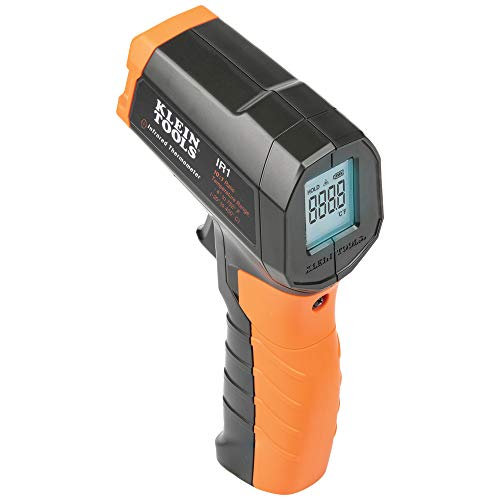
- 10:1 optical resolution
- Fixed 0.95 emissivity
- Laser, backlit display, and auto-hold
Best For: Routine workshop, DIY, and maintenance checks
Best for Cooking and HVAC

- -58°F to 1,022°F range
- Adjustable 0.1–1.0 emissivity
- MAX, MIN, and AVG scan readings
Best For: Pizza ovens, griddles, HVAC, automotive, and home repairs
Best Rugged Industrial Pick

- -22°F to 932°F range
- IP54 dust and splash protection
- 3-meter drop resistance and 3-year warranty
Best For: Industrial electrical, mechanical, HVAC, and automotive work
Best Hybrid Pick

- Infrared and probe functions in one tool
- 12:1 distance-to-spot ratio with adjustable emissivity
- Includes cooking-friendly convenience features
Best For: Home cooks, grillers, and DIY users needing surface and internal readings
Best for Workshop Precision
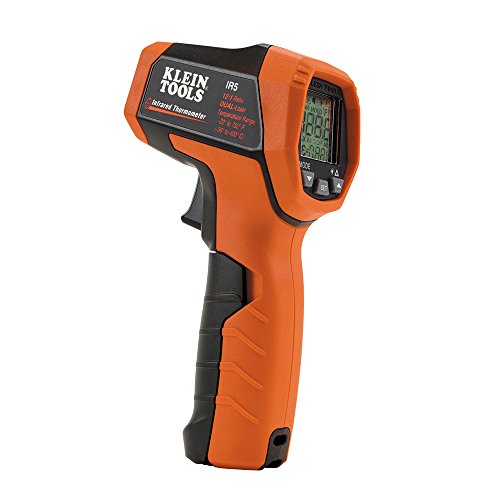
- Dual laser targeting for surface scans
- Measures from -22°F to 752°F
- Includes multiple calculation modes and alarms
Best For: Workshop, HVAC, maintenance, and technical troubleshooting
Best Wide-Range Value

- Measures from -58°F to 1,130°F
- 12:1 distance-to-spot ratio with adjustable emissivity
- Fast readings with backlit display and max-temperature mode
Best For: High-heat, cold-surface, home maintenance, and cooking checks
Most Versatile

- Dual-laser targeting with adjustable emissivity
- 16:1 distance-to-spot ratio
- MAX/MIN/AVG temperature tracking
Best For: Kitchen, garage, HVAC, and automotive tasks
Best Display
Etekcity Lasergrip Color Display

- Color LCD with large readable fonts
- -58°F to 1,130°F measurement range
- Adjustable emissivity and fast readings
Best For: Clear readings across cooking and household projects
Best Calibration Feature

- One-button calibration function
- -58°F to 1,112°F measurement range
- Backlit LCD with auto-shutoff
Best For: Repeatable cooking, HVAC, automotive, and DIY checks
Best Overall Value – Etekcity Lasergrip 774
The Etekcity Lasergrip 774 is a versatile choice for shoppers comparing infrared thermometers for home maintenance, cooking, automotive checks, and general outdoor use. Its 12:1 distance-to-spot ratio, broad temperature range, and quick backlit display make routine surface checks convenient.
Best For: Homeowners who want a fast, general-purpose infrared thermometer with a wide measurement range.
Pros:
- Measures from -58°F to 842°F (-50°C to 450°C).
- 12:1 distance-to-spot ratio supports measurements from a comfortable distance.
- Displays readings in less than half a second and includes a backlit LCD.
- Includes two AAA batteries and a two-year warranty.
Cons:
- Its reading represents the average temperature across the targeted circular area.
- As a surface thermometer, it is not presented as a human or animal temperature device.
The Lasergrip 774 stands out for combining useful range, simple operation, and accessible battery power. It is a practical all-around pick when you need one thermometer for varied non-contact surface measurements.
Best for Straightforward Measurements – Klein Tools IR1
The Klein Tools IR1 is a straightforward option among infrared thermometers, with a 10:1 optical resolution, laser targeting, and a fixed emissivity of 0.95. Its design suits users who want consistent surface readings without adjusting emissivity for each material.
Best For: DIYers and tradespeople who prefer simple, repeatable surface measurements.
Pros:
- Measures temperatures from -4°F to 752°F (-20°C to 400°C).
- 10:1 distance-to-spot ratio helps support readings from a distance.
- Includes laser targeting, a backlit display, auto-hold, and auto power off.
- Comes with a custom pouch and one 9V battery.
Cons:
- Fixed emissivity of 0.95 offers less adjustment flexibility across different surfaces.
- It is intended for non-medical use and is not designed for people or animals.
- Its temperature range is narrower than some competing models in this roundup.
The IR1 favors ease of use over extensive customization. Its fixed-emissivity setup and practical targeting features make it a sensible choice for routine maintenance and workshop checks.
Best for Cooking and HVAC – TempPro TempScan
The TempPro TempScan is a flexible infrared thermometer for cooking, pizza ovens, griddles, HVAC vents, and automotive work. Adjustable emissivity from 0.1 to 1.0 helps tailor readings to different surface materials, while MAX, MIN, and AVG functions add useful context to each scan.
Best For: Cooks, homeowners, and technicians who need broad temperature coverage and adjustable surface settings.
Pros:
- Wide -58°F to 1,022°F measurement range.
- Adjustable emissivity from 0.1 to 1.0 supports different surfaces.
- 12:1 distance-to-spot ratio and response time under 500 milliseconds.
- Backlit LCD displays MAX, MIN, and AVG readings from the last scan.
Cons:
- Accurate readings depend on selecting an appropriate emissivity setting.
- The product notes identify it as rechargeable while also listing two AAA batteries, so power details may require clarification.
- It has a plastic construction and a shorter 3.74-inch length than some full-size models.
With its unusually high upper limit and adjustable emissivity, the TempScan is especially appealing for high-heat cooking and varied repair tasks. Its stored scan statistics also make it more informative than a basic single-reading thermometer.
Best Rugged Industrial Pick – Fluke 62 MAX
The Fluke 62 MAX is a rugged choice among infrared thermometers for industrial surface checks. It covers -22°F to 932°F, offers laser targeting and a 10:1 distance-to-spot ratio, and adds IP54 protection plus a three-year warranty for demanding work environments.
Best For: Electrical, mechanical, HVAC, and automotive professionals who need a durable field instrument.
Pros:
- Measures from -22°F to 932°F (-30°C to 500°C).
- IP54-rated protection helps guard against dust and splashing liquid.
- Designed to withstand a 3-meter drop and clips easily to a tool belt or belt loop.
- Displays minimum, maximum, difference, and average temperatures.
Cons:
- It is for industrial use only and not intended for human temperature measurement.
- Its 10:1 distance-to-spot ratio is less extensive than the 12:1 models in this roundup.
- It uses a single AA battery and has a stated battery life of 10 hours.
The 62 MAX prioritizes durability and field practicality over consumer-oriented extras. Its protective rating, drop resistance, measurement statistics, and three-year warranty make it the strongest fit for professional maintenance work.
Best Hybrid Pick – TempScan 2-in-1 Thermometer
For home cooks who want more than surface readings, this infrared thermometer combines non-contact scanning with a fold-out meat probe. Its 12:1 distance-to-spot ratio, adjustable emissivity, and 1,022°F upper range make it useful for checking cookware, grills, ovens, and other hot surfaces.
Best For: Home chefs, grillers, candy makers, and DIY users who need both surface and internal temperature readings.
Pros:
- Combines infrared surface measurement with a meat probe.
- Measures internal temperatures in 2–3 seconds with stated ±1.8°F precision.
- Includes adjustable emissivity, auto-off, °F/°C switching, a magnet, and a hanging hole.
Cons:
- Requires two AAA batteries.
- The probe function adds bulk compared with a basic infrared-only thermometer.
The TempScan is the most versatile choice here if you regularly switch between checking hot surfaces and measuring food interiors. Choose it over a dedicated surface scanner when the built-in probe would simplify your cooking workflow.
Best for Workshop Precision – Klein Tools IR5 Thermometer
The Klein Tools IR5 is a focused infrared thermometer for workshop and maintenance tasks. Dual targeting lasers, a 12:1 optical resolution, and a -22°F to 752°F measurement range help you scan surfaces from a practical distance.
Best For: HVAC, electrical, maintenance, and general workshop users who want measurement modes and adjustable emissivity.
Pros:
- Dual laser targeting helps identify the measurement area.
- Offers max, min, average, and difference calculation modes.
- Includes adjustable 0.1–1.0 emissivity, high/low alarms, and a backlit display.
Cons:
- Its 752°F maximum is lower than some competing infrared thermometers.
- Designed for non-medical use and not intended for people or animals.
With its calculation modes and targeting lasers, the IR5 is better suited to technical troubleshooting than casual kitchen use. It is a strong pick when comparing temperature differences or monitoring alarm thresholds matters.
Best Wide-Range Value – Etekcity Lasergrip 1080
For users who need an unusually broad temperature range, the Etekcity Lasergrip 1080 covers -58°F to 1,130°F. This non-contact infrared thermometer also provides a 12:1 distance-to-spot ratio, adjustable emissivity, a backlit display, and a max-temperature readout.
Best For: Heat-gun, oven, automotive, HVAC, cooking, and general home maintenance checks involving very hot or very cold surfaces.
Pros:
- Wide -58°F to 1,130°F measurement range.
- Adjustable 0.1–1.0 emissivity supports different surface materials.
- Fast 0.5-second response, backlit display, auto-off, and low-battery indicator.
Cons:
- It measures surface temperature and does not include a probe for internal readings.
- Best results call for measuring from approximately 14.17 inches away.
- Listed for indoor use.
The Lasergrip 1080 stands out when range is the deciding factor, especially for high-heat applications. If you mainly measure food interiors or need more advanced comparison modes, a hybrid or feature-focused alternative may fit better.
Most Versatile – TempScan Infrared Thermometer
The TempPro TempScan is one of the more adaptable infrared thermometers for home projects. Its dual-laser targeting, adjustable emissivity, and fast response make it useful for checking pizza ovens, grills, HVAC vents, and automotive components without touching hot surfaces.
Best For: Home cooks, grill enthusiasts, and DIY users who want one thermometer for kitchen, garage, and household tasks.
Pros:
- Dual lasers and adjustable 0.1–1.0 emissivity support accurate surface measurements.
- 16:1 distance-to-spot ratio helps measure hot objects from farther away.
- Displays maximum, minimum, and average readings for tracking temperature changes.
- Fast 0.5-second response and readings up to 1,022°F.
Cons:
- Its indoor-focused usage specification may be less appealing for primarily outdoor applications.
- Requires two AAA batteries, although they are included.
The TempScan stands out when versatility and targeting distance matter. It is especially practical for users who regularly move between cooking, HVAC troubleshooting, and automotive checks.
Best Display – Etekcity Lasergrip Color Display
The Etekcity Lasergrip is a practical choice among infrared thermometers when readable results are a priority. Its color LCD, broad temperature range, and quick trigger operation suit cooking, appliance checks, vehicle work, and general DIY projects.
Best For: Users who want a clearly visible color display and a broad measurement range for indoor and outdoor household tasks.
Pros:
- Measures from -58°F to 1,130°F with stated accuracy of ±2%.
- Large color fonts make readings and maximum temperatures easier to see.
- Adjustable emissivity from 0.1 to 1.0 supports different surface types.
- Provides results in less than 0.5 seconds and includes a two-year warranty.
Cons:
- The 12:1 distance-to-spot specification is less expansive than some longer-range models.
- The product details list it as single-use, despite describing a reusable thermometer design.
With its color screen and wide temperature span, the Lasergrip is a strong everyday option for people who value quick, easy-to-read measurements over specialized targeting features.
Best Calibration Feature – UW510 Infrared Thermometer
The UW510 adds a one-button calibration function to the core features expected from infrared thermometers. It provides non-contact readings across a wide range, with applications from cooking and frying oil to HVAC, automotive, appliance, and electronics checks.
Best For: Users who want a compact, fast thermometer with calibration support for recurring kitchen, maintenance, and DIY measurements.
Pros:
- One-button CAL function is designed to help maintain measurement consistency over time.
- Measures from -58°F to 1,112°F and responds in as little as 0.5 seconds.
- Backlit LCD supports viewing in low-light conditions.
- Includes auto-shutoff and a low-battery indicator.
Cons:
- The supplied details do not specify a distance-to-spot ratio or laser-targeting configuration.
- It requires two AAA batteries, though batteries are included.
The UW510 is worth considering when calibration is a key buying criterion. Its broad range and straightforward design make it suitable for varied household and hobbyist work.
How We Picked These Infrared Thermometers
We selected models that cover a broad range of use cases, from checking pizza ovens and griddles to diagnosing HVAC equipment and monitoring machinery. Our comparison emphasizes measurement range, targeting accuracy, distance-to-spot ratio, emissivity adjustment, display readability, response speed, and overall practicality.
We also considered useful extras such as dual lasers, auto-hold, minimum and maximum readings, color displays, calibration controls, water and dust resistance, and built-in probes. A wide range alone does not guarantee better results, so the best choice depends on the surfaces and temperatures you measure most often.
Quick Comparison
- Best for general home use: Choose a simple Etekcity or Klein Tools model with a clear display and straightforward controls.
- Best for cooking: A TempPro model designed for pizza ovens, grills, or griddles can offer a practical range and, in some cases, a meat probe.
- Best for industrial work: The Fluke 62 MAX and Klein Tools IR5 stand out for tougher job-site use, targeting, and durable construction.
- Best for extreme temperatures: Look for models rated from roughly -58°F to above 1,000°F.
- Best for flexible readings: Select a thermometer with adjustable emissivity, min/max functions, or calibration controls.
Key Buying Factors for Infrared Thermometers
Temperature Range
Make sure the thermometer’s rated range covers your intended application with room to spare. Cooking tasks generally need less range than furnaces, kilns, automotive systems, or industrial equipment. Do not assume the upper limit means the device can safely measure every material at that temperature.
Distance-To-Spot Ratio
The distance-to-spot ratio determines how large an area is measured from a given distance. A 12:1 model can measure a smaller target than a 10:1 model from the same distance. Higher ratios are useful when the target is hot, inaccessible, or surrounded by cooler surfaces.
Emissivity and Surface Type
Infrared readings can be inaccurate on shiny metal, glass, and reflective surfaces. Adjustable emissivity helps compensate for different materials, while matte, nonreflective surfaces usually produce more dependable readings. When precision matters, verify the reading with a contact thermometer.
Targeting and Durability
A laser helps identify the measurement area, but it does not improve accuracy by itself. Dual lasers may make the target size easier to judge. For professional environments, look for impact resistance, an IP rating, a protective case, and controls that are easy to operate while wearing gloves.
Who Should Buy Which Infrared Thermometers?
Homeowners should prioritize simple controls, a readable backlit or color display, and a useful everyday temperature range. Home cooks and grill users may prefer a cooking-focused model or a 2-in-1 design with a meat probe. HVAC technicians, mechanics, and maintenance teams should look for a narrower measurement area, adjustable emissivity, min/max readings, and dependable targeting. Industrial users should favor rugged construction, a wide operating range, better distance-to-spot performance, and credible protection ratings.
Finally, remember that an infrared thermometer measures surface temperature rather than internal temperature. Use the right tool for the job, keep the lens clean, follow the manufacturer’s distance guidance, and confirm critical readings with an appropriate contact sensor.
