Taylor Analog Kitchen Scale review buyers usually want one thing: a simple, readable scale that does not overcomplicate everyday kitchen work.
The Taylor Analog Kitchen Scale Mechanical Food Scale is aimed squarely at that use case.
Analog Kitchen Scale Review Summary
The Taylor Analog Kitchen Scale makes sense for cooks who want a no-frills mechanical scale with generous capacity, a visible dial, and basic flexibility for standard or metric measuring.
It is especially appealing if you prefer a tool that stays simple at the counter, uses a tare knob instead of digital controls, and can handle larger batches up to 22 lb / 10 kg.
This is not the kind of scale you buy for app features, backlit readouts, or precision gadgetry.
You buy it because Taylor has built around kitchen measurement for a long time, the dial is meant to be easy to read, and the oversized tray gives it a practical edge for heavier ingredients or mixed-use kitchen tasks.
Review Scorecard
| Category | Score | Why it matters |
|---|---|---|
| Ease of use | 9/10 | Mechanical operation is straightforward, with a tare knob and an easy-to-read dial. |
| Capacity | 9/10 | The 22 lb / 10 kg limit is strong for a kitchen scale in this class. |
| Readability | 8/10 | The bright red angled dial and bold graphics are built for quick glances. |
| Versatility | 8/10 | Unit conversion between pounds and kilograms broadens its usefulness. |
| Cleanup | 8/10 | The chrome tray is top-rack dishwasher safe, which helps after messy ingredients. |
| Precision focus | 7/10 | The listing emphasizes accurate weighing, but this is still a mechanical kitchen scale, not a high-end lab tool. |
| Value for practical buyers | 8/10 | It offers useful basics without pushing into feature bloat. |
Key Features and Specifications of Analog Kitchen Scale
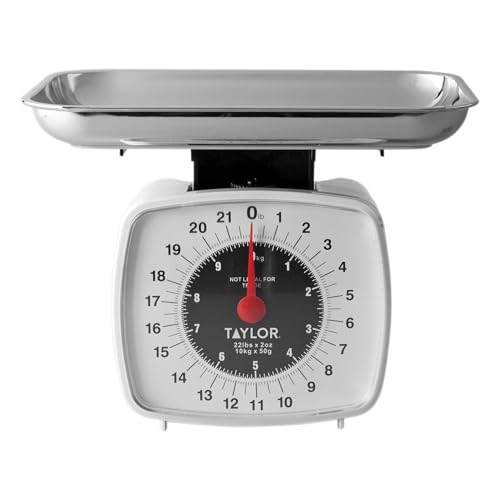
The Taylor Analog Kitchen Scale is a mechanical food scale with a 22 lb / 10 kg capacity and 2 oz / 50 g increments.
That combination makes it a fit for ordinary home cooking, baking prep, and larger kitchen jobs where a small scale would feel cramped.
The most visible design choice is the angled bright red dial, paired with bold black-and-white graphics.
Taylor clearly designed it to be readable at a glance.
In a kitchen, that matters more than people sometimes expect, especially when the scale is sitting under less-than-ideal lighting or being checked while hands are busy.
The scale includes an easy tare knob at the top.
That lets you zero the tray before adding ingredients, or reset it between additions.
For recipes that move from one component to another, that is the right kind of simple control: mechanical, direct, and not dependent on menus or buttons.
The weighing surface is an oversized chrome tray with a raised edge.
That is useful for ingredients that need a little containment, and it also gives the scale a more accommodating footprint for bulky items.
Taylor also says the tray is top-rack dishwasher safe, which is a practical detail for a kitchen tool likely to see flour, produce, or other messier use.
Taylor also positions the scale around long-standing precision-product manufacturing for kitchen measurement.
That does not automatically make it better than every alternative, but it does reinforce the intent: this is a purpose-built kitchen measuring tool, not a novelty item.
At a glance
| Spec | Detail |
|---|---|
| Brand | Taylor |
| Product type | Analog/mechanical kitchen scale |
| Maximum capacity | 22 lb / 10 kg |
| Increment | 2 oz / 50 g |
| Units | Pounds and kilograms |
| Tare control | Top-mounted tare knob |
| Tray | Oversized chrome tray with raised edge |
| Cleanup | Top-rack dishwasher safe tray |
Pros and Cons of Analog Kitchen Scale
Pros
- Simple mechanical operation with no learning curve.
- Clear dial design that is easier to read than many plain analog faces.
- Good capacity for home kitchens at 22 lb / 10 kg.
- Tare function makes multi-ingredient prep more convenient.
- Large chrome tray is practical for bigger items.
- Dishwasher-safe tray simplifies cleanup.
Cons
- Not the best fit for users who want digital precision features or modern convenience extras.
- 2 oz / 50 g increments are fine for many kitchen tasks, but not ideal if you want very fine gram-level tuning.
- Mechanical scales can be less exact-feeling than digital alternatives for small measurements.
- The tray and dial style are functional rather than refined, so design-first buyers may prefer something sleeker.
Who Should Buy Analog Kitchen Scale?
This scale is a good match for home cooks who want a dependable, easy-to-read kitchen tool without digital complexity.
It also makes sense for bakers or meal preppers who routinely weigh moderate to large amounts and want the convenience of a tare knob and a roomy tray.
It is also a sensible pick for buyers who like analog tools.
Some kitchens work better when the equipment is tactile and obvious.
If that sounds like you, the Taylor scale offers the kind of straightforward operation that stays out of the way.
You should probably skip it if you need very fine measurement resolution, frequent switching among specialized units, or a more compact scale for tiny portions.
If your cooking centers on small-quantity precision, a digital model may be the better fit.
How the Analog Kitchen Scale Fits Real Kitchen Use
Tare and Multi-Ingredient Prep
The tare knob is one of the most useful parts of the design.
It lets you reset the scale between ingredients, which makes it easier to build a recipe in the same tray or container without doing mental subtraction.
That is a practical feature, not a flashy one, and it is exactly the kind of function that makes a kitchen scale worth keeping out on the counter.
Dial Readability and Everyday Visibility
The angled red dial and bold graphics are a strong sign that Taylor prioritized readability.
With analog tools, face design is not cosmetic.
A clear dial reduces second-guessing when you are moving quickly, and it makes the scale feel more usable in the real world.
Tray Size and Cleanup
The oversized chrome tray is a meaningful advantage if you often weigh larger ingredients or want a more forgiving platform.
The raised edge helps keep food from sliding off, and the fact that the tray is dishwasher safe on the top rack makes cleanup easier after flour, produce, or sticky ingredients.
Capacity and Measurement Range
The 22 lb / 10 kg capacity gives this scale broader utility than many lighter-duty kitchen scales.
For a household tool, that is a strong practical ceiling.
The 2 oz / 50 g increments are not ultra-fine, but they are consistent with the scale’s role as an everyday measuring tool rather than a specialty precision instrument.
Alternatives to Analog Kitchen Scale
If you want a different approach, a few Amazon-available alternatives are worth comparing:
- OXO Good Grips kitchen scale for buyers who prefer a more modern digital experience.
- Escali kitchen scale for a straightforward household scale from a well-known kitchen-measurement brand.
- Etekcity digital kitchen scale for shoppers who care more about digital convenience than analog simplicity.
- Taylor digital kitchen scale if you like the brand but want a different format.
These alternatives make sense if you want a more compact footprint, different display style, or digital readout.
But if the goal is a readable mechanical scale with a larger tray and a simple tare control, the Taylor analog model still has a clear case.
Is Analog Kitchen Scale Worth It?
Yes, if you want a durable, uncomplicated kitchen scale with a large capacity and easy day-to-day operation.
The Taylor Analog Kitchen Scale is not built to impress with features; it is built to be used.
The strongest reasons to buy it are the 22 lb / 10 kg capacity, the visible dial, the tare knob, and the oversized chrome tray.
The biggest reason to skip it is also straightforward: if you want finer precision or a digital workflow, this is not that product.
For most practical home cooks, though, this is a sensible, low-drama tool that does the basics well.
If you want an analog kitchen scale with room to work, it is worth considering.
