Choosing the right digital salinity meter can make routine pool, aquarium, pond, and seawater testing faster and more consistent. The models in this roundup range from compact salt testers to multifunction meters that also measure pH, TDS, EC, and temperature.
Use the buying guide below to compare measurement range, temperature compensation, waterproofing, calibration, and the features that matter most for your water-testing routine.
Best 10 Digital Salinity Meters Picks for 2026
Best Refractometer Alternative
Agriculture Solutions Salinity Refractometer

- Reads specific gravity and parts per thousand
- Automatic temperature compensation
- Includes case, dropper, tools, and cleaning cloth
Best For: Marine aquariums and fishkeeping
Best for Saltwater Pools

- Measures salt, pH, TDS, EC, and temperature
- Salt range up to 100 ppt
- Includes calibration powder and battery
Best For: Saltwater pools, hot tubs, and spas
Best Digital Refractometer

- Displays PSU, ppt, and specific gravity
- Automatic temperature compensation with 1.5-second response
- Easy-clean glass prism and stainless-steel well
Best For: Saltwater aquariums and reef tanks
Best Pool-Only Option
SALT-3050 Waterproof Salinity Meter

- Measures 0–9999 ppm or 0.0–1.0% salt
- Includes temperature readings
- IP65 waterproof-rated design
Best For: Saltwater pools and koi ponds
Best Unit-Reading Flexibility
Hofun 5-in-1 Salinity pH Meter
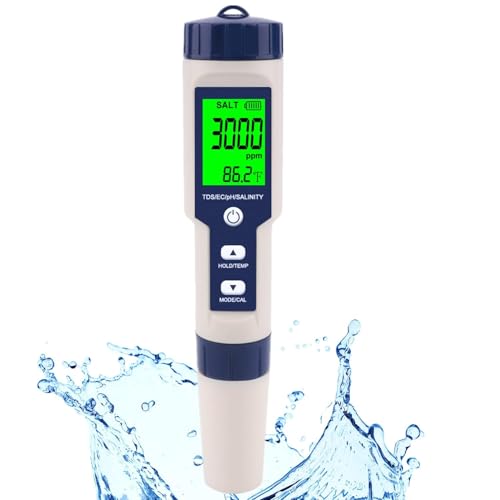
- Tests salinity, pH, EC, TDS, and temperature
- Displays ppm, ppt, and percent
- Covers pools, seawater, aquariums, and hydroponics
Best For: Multi-purpose testing with flexible salinity units
Dedicated Pool & Pond Pick
SALT-3000 Digital Salinity Meter

- 0–9,990 ppm salt range
- Precalibrated at 3,000 ppm NaCl
- Not waterproof or marine-aquarium compatible
Best For: Saltwater pools and koi ponds
Versatile Aquarium Pick

- Measures salinity, specific gravity, and temperature
- Automatic temperature compensation
- Life waterproof pen-style design
Best For: Aquariums, pools, hydroponics, and aquaculture
Multi-Parameter Pool Pick

- Tests salinity, pH, TDS, EC, and temperature
- Supports pool, seawater, aquarium, and hot-tub testing
- Displays ppm, ppt, and percentage
Best For: Comprehensive pool and aquarium water checks
Best All-Around Digital Salinity Meter – ORAPXI 4-in-1 Tester
For shoppers comparing digital salinity meters, the ORAPXI offers broad testing coverage in a compact, waterproof design. It measures salinity, TDS, EC, and temperature, with a 0–200 ppt saltwater range, automatic temperature compensation, and a backlit display.
Best For: Aquariums, seawater, marine monitoring, saltwater pools, and koi ponds.
Pros:
- Measures salinity, TDS, EC, and temperature.
- Automatic temperature compensation helps reduce temperature-related error.
- IP67 waterproof construction and a backlit LCD support convenient use.
Cons:
- Its many measurement modes may be more than users need for basic salinity checks.
- The supplied notes do not specify a measurement response time or included calibration materials.
This is a versatile choice when you want one handheld meter for several regular water-testing tasks. Its wide application range makes it especially practical for mixed aquarium, pond, and pool use.
Best Refractometer Alternative – Agriculture Solutions Salinity Refractometer
Although it is not an electronic meter, this salinity refractometer is a useful comparison point for buyers evaluating digital salinity meters. It measures saltwater on specific-gravity and parts-per-thousand scales and includes automatic temperature compensation for aquarium and marine applications.
Best For: Marine aquariums and fishkeepers who prefer a manual refractometer with a protective case.
Pros:
- Measures specific gravity and parts per thousand.
- Automatic temperature compensation supports more convenient readings.
- Includes a hard case, dropper, screwdriver, manual, and cleaning cloth.
Cons:
- It is a manual refractometer rather than a digital salinity meter.
- Readings require placing a sample and viewing the scale.
This model suits shoppers who value a traditional, durable testing format and useful accessories. Choose it when specific gravity and ppt readings are more important than electronic operation.
Best for Saltwater Pools – ORAPXI 5-in-1 Pool Tester
Among digital salinity meters, this ORAPXI model is tailored toward pool maintenance because it combines salt testing with pH, TDS, EC, and temperature readings. Its salt range reaches 100 ppt, while the pH function covers 0.00–14.00 for checking pool and hot-tub water conditions.
Best For: Saltwater pool, hot-tub, spa, and swim-spa owners using salt chlorine generators.
Pros:
- Measures salinity, pH, TDS, EC, and temperature.
- Designed to help monitor salt concentration for salt chlorine generators.
- Includes a battery, brush, user manual, and calibration powder.
Cons:
- The maximum listed salt range is 100 ppt, lower than some aquarium-focused models.
- Its pool-oriented feature set may be unnecessary for users who only need salinity.
This is a practical pick for maintaining saltwater pools and related recreational water systems. The added pH function can reduce the need for separate testers when routine pool checks are the priority.
Best Digital Refractometer – Milwaukee MA887
The Milwaukee MA887 is a dedicated digital salinity refractometer for natural or artificial seawater. It displays PSU, ppt, and specific gravity, automatically compensates for temperature, and provides readings in about 1.5 seconds for aquarium and reef-tank testing.
Best For: Saltwater aquarium and reef-tank keepers who want fast readings in multiple salinity units.
Pros:
- Displays PSU, ppt, and specific gravity.
- Automatic temperature compensation and a 1.5-second response time.
- Sealed glass prism and stainless-steel sample well are easy to clean.
Cons:
- It is designed specifically for seawater and aquarium applications rather than broad household water testing.
- The supplied notes list a pipette and manual but do not mention calibration materials.
This model is a strong fit for aquarists who want a focused digital instrument rather than a multipurpose water meter. Its quick response, multiple display units, and easy-clean sample well support repeat reef-tank measurements.
Best Multi-Parameter Pick – YINMIK YK-5 5-in-1 Salt Meter
For shoppers comparing digital salinity meters, the YINMIK YK-5 stands out as a versatile option that combines salinity testing with pH, TDS, EC, and temperature readings. Its broad salt ranges make it practical for pools, koi ponds, seawater, aquariums, spas, and hydroponic systems.
Best For: Users who want one meter for saltwater monitoring and broader water-quality checks.
Pros:
- Measures pH, EC, TDS, salinity, and temperature in one device.
- Supports swimming-pool readings from 0–9990 ppm and seawater readings from 0.00–200.0 ppt.
- Includes calibration buffers and has a replaceable probe.
- Suitable for pools, aquariums, koi ponds, spas, and hydroponics.
Cons:
- Requires calibration and ongoing probe care for reliable readings.
- Uses three LR44 batteries.
The YK-5 is a strong all-purpose choice when salinity is only one part of your testing routine. Its replaceable probe and included calibration supplies add convenience over time, while the multi-parameter design may be more capability than needed for simple pool-only testing.
Best Pool-Only Option – SALT-3050 Waterproof Salinity Meter
If you need digital salinity meters for a saltwater pool or koi pond, the SALT-3050 keeps the job focused. It is precalibrated for a 3000 ppm salt solution at 25°C and displays salt concentration along with temperature in a compact, waterproof-rated body.
Best For: Saltwater pool and koi pond owners who need dedicated salt-level testing.
Pros:
- Measures salt from 0–9999 ppm or 0.0–1.0%.
- Also measures temperature from 0–55°C or 32–130°F.
- Has an IP65 waterproof rating.
- Precalibrated at 3000 ppm salt at 25°C.
Cons:
- Works only for saltwater pools and koi fish ponds.
- Not suitable for seawater or marine fish tanks.
- Not designed for food salt testing or other applications.
The SALT-3050 makes sense when you do not need pH, TDS, or EC functions and want a purpose-built pool or pond tester. Its application limits are significant, so confirm your water type before choosing it.
Best Unit-Reading Flexibility – Hofun 5-in-1 Salinity pH Meter
The Hofun is one of the more flexible digital salinity meters for users who prefer multiple display formats. It combines salinity, pH, temperature, EC, and TDS testing, with readings available in ppm, ppt, and percent for pool, aquarium, seawater, spa, and hydroponic applications.
Best For: Users who want multi-parameter testing and straightforward salinity readings in several units.
Pros:
- Combines salinity, TDS, EC, pH, and temperature functions.
- Displays salinity in ppm, ppt, and percent.
- Supports pool readings up to 9999 ppm and seawater readings up to 200 ppt.
- Uses a titanium alloy probe for quick and accurate water-quality testing, according to the supplied product notes.
Cons:
- Its broad functionality may be unnecessary for pool-only salt testing.
- The supplied notes do not specify included calibration supplies or a replaceable probe.
The Hofun offers a useful balance of convenience and range, especially if you switch between pool, aquarium, and hydroponic testing. Its selectable units can simplify interpretation, while buyers seeking included calibration accessories may prefer a model that lists them explicitly.
Dedicated Pool & Pond Pick – SALT-3000 Digital Salinity Meter
If you need digital salinity meters for a saltwater pool or koi pond, the SALT-3000 keeps the job focused. It measures salt from 0–9,990 ppm, displays readings to 1 ppm, and arrives precalibrated at 3,000 ppm NaCl.
Best For: Saltwater pool and koi pond owners who want a straightforward handheld ppm tester.
Pros:
- Measures a broad 0–9,990 ppm salt range.
- Includes temperature readings from 0–55 °C (32–130 °F).
- Precalibrated at 3,000 ppm for salt testing.
Cons:
- Designed only for saltwater pools and koi ponds.
- Not suitable for marine aquariums, food salt testing, or other applications.
- Not waterproof.
This is a specialized choice rather than an all-purpose water tester. Its clear application limits make it most appropriate when your testing needs are specifically pool or koi-pond salt levels.
Versatile Aquarium Pick – 3-in-1 Saltwater Tester
Among digital salinity meters, this pen-style tester stands out for combining salinity, specific gravity, and temperature readings. Automatic temperature compensation, a backlit LCD, and audible testing alerts make it practical for aquarium, pool, hydroponic, and aquaculture checks.
Best For: Users who need portable salinity and specific-gravity monitoring across aquariums, pools, or aquaculture setups.
Pros:
- Measures specific gravity, salinity from 0–55 ppt, and temperature from 1–99 °C.
- Offers automatic temperature compensation and a backlit display.
- Life waterproof design supports indoor and outdoor testing.
- Automatically powers off after 60 seconds and includes a low-battery indicator.
Cons:
- Requires two AAA batteries.
- Salinity accuracy is listed as ±1 ppt, so it may not suit applications requiring finer accuracy.
Its three measurement modes and portable pen format provide useful flexibility. Consider it when you want more than a single salinity reading and value convenient field testing.
Multi-Parameter Pool Pick – 5-in-1 Pool Salt Tester
For shoppers comparing digital salinity meters with broader water-testing capabilities, this multifunction tester adds pH, TDS, EC, and temperature measurements. It supports pool, seawater, aquarium, hot-tub, and food-related salinity ranges, with readings shown in ppm, ppt, or percentage.
Best For: Pool and aquarium owners who want one device for salinity plus several general water-quality measurements.
Pros:
- Combines salinity, pH, TDS, EC, and temperature testing.
- Supports pool readings up to 9,999 ppm and seawater readings from 10–200 ppt.
- Displays salinity in ppm, ppt, or percentage.
- Designed for swimming pools, aquariums, hot tubs, spas, and food testing.
Cons:
- Its broader feature set may be more than needed for simple salt-only testing.
- The supplied notes do not specify numerical accuracy or resolution.
- Calibration materials and manuals are included, so setup may require consulting the documentation.
This is the most versatile option in the group for measuring several water parameters. Choose it when convenience and broad application coverage matter more than a dedicated salt-only design.
How We Picked These Digital Salinity Meters
We selected products for different water-testing needs, including saltwater pools, marine aquariums, koi ponds, seawater, and general water-quality checks. Our comparison emphasizes stated salinity range, measurement format, temperature compensation, waterproofing, included functions, display usability, and the practicality of calibration and maintenance.
Because accuracy can vary with calibration, sample temperature, electrode condition, and water chemistry, specifications should be treated as a starting point. For critical aquarium or pool adjustments, confirm readings with a trusted reference solution or a second testing method.
Quick Comparison
- Basic salinity testing: Choose a dedicated salt or salinity meter when you want a simple reading with minimal setup.
- Marine aquariums: Look for a model that displays salinity clearly and supports temperature compensation or temperature measurement.
- Saltwater pools: A waterproof tester with a broad range and easy calibration is convenient for frequent checks.
- Multiple water parameters: Five-in-one meters can measure pH, TDS, EC, salinity, and temperature, reducing the number of devices needed.
- Refractometer-style testing: Digital refractometers can be useful when you prefer a sample-based reading and a clearly specified salinity scale.
Key Buying Factors for Digital Salinity Meters
Measurement Range and Units
Check whether the meter reports parts per thousand (ppt), parts per million (ppm), practical salinity, specific gravity, or more than one scale. A range suitable for seawater may not be optimized for concentrated brine, while a pool-focused tester may be unnecessary for low-salinity applications.
Accuracy, Resolution, and Calibration
Accuracy describes how close a result may be to the actual value; resolution describes the smallest displayed increment. Look for clear calibration instructions and confirm whether calibration solution is included or must be purchased separately. Regular calibration is especially important when readings guide chemical dosing.
Temperature Compensation and Waterproofing
Automatic temperature compensation, commonly listed as ATC, helps account for temperature-related changes in conductivity-based measurements. Waterproof or water-resistant construction is useful around pools and ponds, but verify the stated IP rating and avoid submerging a device beyond its specified limits.
Extra Functions and Usability
pH, EC, TDS, and temperature functions can add value, but only if you need them and are willing to maintain the additional sensors. A large display, automatic shutoff, replaceable electrode, stable calibration, and simple one-button operation can matter more than a long feature list.
Who Should Buy Which Digital Salinity Meters?
Pool owners should prioritize a waterproof salt meter with a suitable pool range, readable display, and dependable calibration. Marine aquarium keepers should favor salinity or specific-gravity readings, temperature support, and consistent repeatability over extra functions they will not use.
Koi pond owners may benefit from a durable, broad-range tester that also measures temperature. Home users testing several water parameters can choose a multifunction model, while buyers seeking straightforward sampling may prefer a digital refractometer. Whichever style you choose, rinse the probe with clean water after use, store it as directed, and calibrate it on the schedule recommended by the manufacturer.
