Stable salinity is essential for marine fish, corals, and invertebrates. The right meter makes routine water checks faster and helps you catch evaporation, mixing, or top-off problems before livestock is stressed.
Our roundup compares 10 salinity-testing options, from simple hydrometers and optical refractometers to digital meters and connected aquarium monitors. Use the guide below to match accuracy, convenience, and budget to your tank.
Best 10 Salinity Meters for Aquariums Picks for 2026
Best Refractometer
SunGrow Aquarium Refractometer

- Designed for seawater and saltwater
- Temperature calibration from 50°F to 86°F
- Includes case, pipette, and calibration tool
Best For: Reef tanks and marine aquariums targeting 35 ppt
Best Compact Checker
Hanna HI98319 Marine Salinity Tester

- Compact and portable design
- Simple button-operated interface
- Includes battery, cuvettes, and starter kit
Best For: Portable aquarium and marine biology testing
Best Simple Hydrometer

- Easy-to-read specific-gravity scale
- Accuracy of ±0.001 specific gravity units
- Calibrated for 68°F–85°F aquariums
Best For: Routine analog salinity checks in warm aquariums
Best Value Refractometer
Aquarium Salinity Refractometer

- Dual specific-gravity and salinity scales
- ATC-assisted optical readings
- Includes case and testing accessories
Best For: Routine saltwater testing on a budget
Best Smart Monitor
Wi-Fi Aquarium Water Quality Monitor
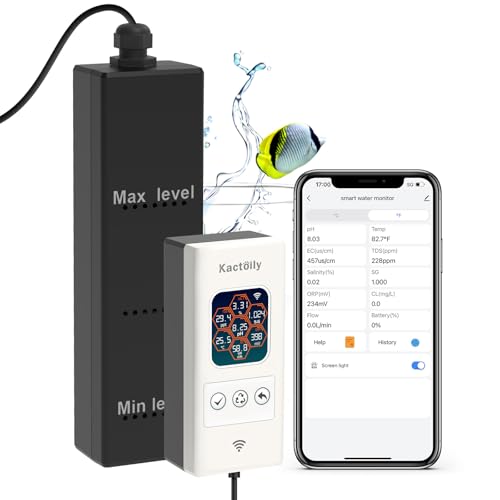
- Tracks seven water parameters
- 24/7 Wi-Fi monitoring and alerts
- Includes pH and ORP calibration powders
Best For: Remote, continuous aquarium monitoring
Best Dual-Scale Pick
AUTOUTLET Saltwater Refractometer

- 0.001 specific-gravity resolution
- ATC range from 10°C to 30°C
- Lightweight aluminum construction
Best For: Portable marine aquarium salinity checks
Best Multiparameter Pick
Hofun 5-in-1 Digital Salinity Meter
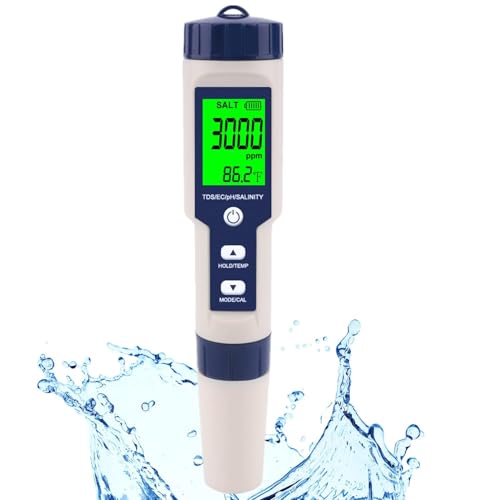
- Tests salinity, pH, temperature, EC, and TDS
- Shows salinity in ppm, ppt, and percentage
- Designed for aquariums, seawater, koi, pools, and spas
Best For: Aquarium owners wanting several water tests in one device
Best Heavy-Duty Pick
hygger Acrylic Aquarium Salinity Tester

- Measures salinity and specific gravity
- Temperature-corrected accuracy of +/-0.001
- Stable, transparent acrylic swing-arm design
Best For: Marine and brackish tanks needing simple salinity checks
Best Easy-Read Digital Option
T TESTRUST 5-in-1 Salinity Meter

- Measures salinity, pH, TDS, EC, and temperature
- Displays salinity in ppm, ppt, and percentage
- Clear LCD for aquarium, pool, spa, and seawater testing
Best For: Users wanting a digital all-in-one tester with quick readings
Best Multi-Parameter Pick – ORAPXI Digital Salinity Tester
For shoppers comparing salinity meters for aquariums, the ORAPXI digital tester is a versatile option that checks salinity, TDS, EC, and temperature. Its broad measurement range, automatic temperature compensation, and waterproof IP67 design suit saltwater tanks, seawater, and koi ponds.
Best For: Aquarium owners who want one handheld meter for several water-quality readings.
Pros:
- Measures salinity, TDS, EC, and temperature.
- Offers automatic temperature compensation from 32°F to 140°F.
- Waterproof IP67 construction and a backlit LCD support convenient use.
- Measures salinity from 10–200 ppt or 0.0–25%, depending on mode.
Cons:
- Its multiple measurement modes may be more than needed for simple salinity checks.
- The notes do not specify included calibration accessories.
The ORAPXI stands out when flexibility matters. It is a practical choice for users who want quick digital readings across aquarium and pond applications rather than a dedicated analog instrument.
Best Refractometer – SunGrow Aquarium Refractometer
SunGrow Measure Salinity of Water with Aquarium Refractometer, Remarkable Accuracy, Easy Reading
Check Price On AmazonThe SunGrow refractometer is designed specifically for saltwater aquarium and reef-tank testing. For anyone comparing salinity meters for aquariums, its aquarium-focused calibration, temperature compensation, and optical display make it a straightforward choice for checking marine water.
Best For: Reef and saltwater aquarium keepers targeting a 35 ppt salinity level.
Pros:
- Algorithm is designed for seawater and saltwater rather than general-purpose liquids.
- Automatic temperature calibration covers ambient temperatures from 50°F to 86°F.
- Focus-adjustable eyepiece helps produce a sharp, readable measurement line.
- Includes a hard case, pipette, and calibration tool.
Cons:
- Requires a calibration process before use.
- As an optical refractometer, it is not a one-button digital tester.
SunGrow is a focused pick for marine aquariums where clear optical readings and purpose-built seawater calibration are priorities. The included accessories also make storage and setup more convenient.
Best Compact Checker – Hanna HI98319 Marine Salinity Tester
The Hanna HI98319 is a compact handheld marine salinity checker for direct measurement. It is worth considering among salinity meters for aquariums if portability and simple button operation matter, especially for aquarium or marine biology applications.
Best For: Users who want a portable marine salinity checker with a straightforward interface.
Pros:
- Compact design is convenient for on-the-go testing.
- Designed for aquarium and marine biology applications.
- Simple button operation supports easy navigation.
- Includes cuvettes, a reagent starter kit, battery, and instructions.
Cons:
- The supplied notes do not list the tester’s measurement range or accuracy.
- Its included reagent kit and cuvettes may be unnecessary for users seeking only basic salinity testing.
The HI98319 is a sensible compact option when easy handling and portability are more important than a long list of published specifications. The one-year manufacturer warranty adds useful purchase support.
Best Simple Hydrometer – Coralife Deep Six Hydrometer
The Coralife Deep Six is a traditional hydrometer for aquarium fish tanks, offering an easy-to-read specific-gravity scale. For shoppers comparing salinity meters for aquariums, it provides a simple, dedicated way to track saltwater conditions without electronic controls or batteries.
Best For: Aquarium owners who prefer a basic analog hydrometer for routine salinity checks.
Pros:
- Easy-to-read scale with clear markings.
- Rated accurate to ±0.001 specific gravity units.
- Bubble-resistant design is intended to support reliable readings.
- Calibrated for warm aquariums from 68°F to 85°F.
Cons:
- Reports specific gravity rather than a digital ppt salinity value.
- Its calibration range is intended for warm aquariums.
- Does not provide the extra water-quality measurements offered by multiparameter testers.
The Deep Six is a practical low-complexity choice for fishkeepers who want a dedicated salinity tool. Its warm-aquarium calibration and bubble-resistant construction make it especially suited to routine tank monitoring.
Best Value Refractometer – Aquarium Salinity Refractometer
If you want a straightforward option among salinity meters for aquariums, this manual refractometer checks both specific gravity and parts per thousand. Its ATC function and optical eyepiece make it practical for routine saltwater testing without batteries.
Best For: Aquarium owners who want a portable, dual-scale tester for seawater and saltwater pools.
Pros:
- Measures specific gravity from 1.000 to 1.070 and salinity from 0 to 100‰.
- Automatic temperature compensation helps simplify readings.
- Includes a case, dropper, screwdriver, and cleaning cloth.
- Aluminum and ABS construction is designed to resist rust and abrasion.
Cons:
- Requires placing sample drops on the prism and reading through the eyepiece.
- Does not provide continuous or app-based monitoring.
This is a sensible pick for hobbyists who prefer a compact, reusable optical tester and need both common salinity measurement scales in one tool.
Best Smart Monitor – Wi-Fi Aquarium Water Quality Monitor
For aquarists who want more than occasional spot checks, this smart monitor combines salinity measurement with several other water-quality readings. It connects over Wi-Fi and can send alerts through the Tuya Smart app, phone, or SMS when customized limits are exceeded.
Best For: Freshwater or saltwater fishkeepers who want remote, continuous monitoring from a smartphone.
Pros:
- Monitors pH, ORP, salinity, specific gravity, TDS, EC, and temperature in one device.
- Provides 24/7 online monitoring through Wi-Fi connectivity.
- Supports customizable high and low parameter alerts.
- Includes pH and ORP calibration powders for three-point pH calibration and ORP calibration.
Cons:
- EC calibration solution is not included and must be purchased separately.
- Probe placement matters; saltwater readings should be taken in consistent flow and away from protein separators.
- Requires attention to probe protection and calibration procedures.
This is the most feature-rich choice here, particularly for tank owners who value remote alerts and broader water-quality tracking rather than salinity readings alone.
Best Dual-Scale Pick – AUTOUTLET Saltwater Refractometer
This AUTOUTLET model is a compact option for shoppers comparing salinity meters for aquariums and marine applications. It uses dual specific-gravity and salinity scales, offers ATC from 10°C to 30°C, and provides a lightweight aluminum body with a rubberized grip.
Best For: Marine aquarium keepers who want a durable, portable refractometer with fine specific-gravity resolution.
Pros:
- Measures specific gravity from 1.000 to 1.070 with 0.001 resolution.
- Measures salinity from 0 to 100‰ with 1‰ resolution.
- Automatic temperature compensation operates from 10°C to 30°C.
- Includes a pipette, cleaning cloth, user manual, and screwdriver.
Cons:
- Requires manual sample collection and optical reading.
- Does not offer continuous monitoring or smartphone connectivity.
Choose this model if portability, a durable aluminum build, and clear dual-scale measurement matter more to you than automated data logging or broader water testing.
Best Multiparameter Pick – Hofun 5-in-1 Digital Salinity Meter
For shoppers comparing salinity meters for aquariums, the Hofun combines salt, pH, temperature, EC, and TDS testing in one handheld device. It offers multiple salinity displays and a broad range for aquarium, seawater, koi, pool, and spa applications.
Best For: Aquarium owners who want one meter for salinity and several additional water-quality readings.
Pros:
- Combines salinity, TDS, EC, pH, and temperature functions.
- Displays salinity in ppm, ppt, and percentage formats.
- Uses a titanium-alloy probe for quick measurements, according to the supplied specifications.
- Supports aquarium, marine-monitoring, koi, pool, and spa testing.
Cons:
- Its broad feature set may be more than needed if you only test salinity.
- The supplied notes do not specify battery life or calibration details.
The Hofun is a practical choice when versatility matters more than a single-purpose design. Its five testing modes can reduce the need for separate instruments, though buyers seeking only salinity readings may prefer a simpler meter.
Best Heavy-Duty Pick – hygger Acrylic Aquarium Salinity Tester
If you prefer a straightforward approach to testing, the hygger is a transparent hydrometer made for salinity and specific-gravity checks. Among salinity meters for aquariums, this manual design is easy to operate: fill it with tank water, place it on a level surface, and read the swing-arm scale.
Best For: Marine and brackish aquarium keepers who want a simple salinity and specific-gravity tester.
Pros:
- Measures both salinity and specific gravity.
- Temperature-corrected readings are specified as accurate to +/-0.001.
- Wide, stable base and swing-arm pointer are designed for easy reading.
- Transparent acrylic construction makes the scales visible.
Cons:
- It does not provide electronic pH, TDS, EC, or temperature readings.
- Requires rinsing and air-drying after use; vinegar soaking is recommended in the supplied instructions.
- Reading requires filling the unit and placing it on a level surface.
The hygger favors uncomplicated operation over multifunctionality. Its stated specific-gravity range and marine-focused scales make it suitable for reef and brackish setups, especially for buyers who do not need a digital multiparameter meter.
Best Easy-Read Digital Option – T TESTRUST 5-in-1 Salinity Meter
The T TESTRUST is a digital option for shoppers seeking salinity meters for aquariums that also monitor broader water conditions. Its five-in-one design measures salinity, pH, TDS, EC, and temperature, with a clear LCD intended to provide quick readings after dipping the probe.
Best For: Beginners and experienced aquarium keepers who want a digital all-in-one water tester.
Pros:
- Combines salinity, pH, TDS, EC, and temperature testing.
- Supports ppm, ppt, and percentage salinity displays.
- Designed for aquarium, pool, hot-tub, spa, and seawater use.
- Offers a user-friendly interface and clear LCD readings.
Cons:
- The product is positioned for multiple water environments, so it may be excessive for salinity-only testing.
- The supplied notes do not provide a stated salinity accuracy specification.
- The notes mention a pH calibration item but do not detail the complete calibration procedure.
T TESTRUST is a versatile choice when convenient digital readings are a priority. Its range of functions can help consolidate routine testing, while buyers focused on independently documented accuracy may want to review the available specifications before purchasing.
How We Picked the Best Salinity Meters for Aquariums
We focused on the factors that matter during real aquarium maintenance: measurement range, readability, portability, calibration needs, durability, and suitability for saltwater. The selection includes refractometers for dependable manual readings, digital testers for quick measurements, hydrometers for low-cost monitoring, and multiparameter devices for broader water-quality checks.
Because product specifications and included accessories can vary, verify the stated range, required calibration solution, battery or probe requirements, and manufacturer instructions before buying. A meter is only useful when it is maintained and used consistently.
Quick Comparison
| Type | Best For | Main Advantage | Watch For |
|---|---|---|---|
| Digital salinity meter | Fast routine checks | Easy-to-read results | Calibration and probe care |
| Refractometer | Marine aquariums and reef tanks | Clear optical scale and no batteries | Requires careful sample placement and calibration |
| Hydrometer | Budget-conscious beginners | Simple, inexpensive operation | Temperature, bubbles, and reading position affect results |
| Smart monitor | Frequent monitoring and alerts | Multiple parameters and connectivity | Higher cost and more setup |
Key Buying Factors for Salinity Meters for Aquariums
Accuracy and Measurement Range
Choose a device that covers the salinity or specific-gravity range used by your aquarium. Reef tanks generally benefit from a tool designed for seawater rather than a general-purpose salt tester. Resolution matters too, especially when maintaining sensitive corals or invertebrates.
Ease of Use and Readability
Large digital displays are convenient for quick checks, while refractometers provide a visual scale that can be easy to interpret in good lighting. Hydrometers are straightforward but may require a level viewing angle and careful bubble removal.
Calibration and Maintenance
Digital meters and refractometers need periodic calibration. Follow the instructions and use appropriate calibration fluid rather than assuming tap or distilled water is sufficient. Rinse probes, cells, and sample surfaces with clean water after use, then store them as directed.
Temperature Compensation and Durability
Automatic temperature compensation can reduce errors when samples are not at the reference temperature, but it does not replace calibration. Waterproof construction helps with aquarium work, while replaceable probes, clear instructions, and reliable battery access improve long-term value.
Who Should Buy Which Salinity Meters for Aquariums?
- Beginners: Choose a straightforward refractometer or hydrometer if you want inexpensive, uncomplicated testing.
- Reef keepers: A calibrated seawater refractometer or dedicated digital marine salinity tester is usually the best fit for repeatable readings.
- Busy aquarium owners: Select a digital meter with a clear display and automatic temperature compensation for faster maintenance.
- Advanced hobbyists: Consider a multiparameter or Wi-Fi monitor when tracking salinity alongside pH, temperature, conductivity, or other readings.
- Multiple tanks: Prioritize portability, durable construction, quick stabilization, and easy cleaning over extra features you will not use.
Whichever model you choose, test at consistent times, keep salinity records, and adjust water gradually. Regular calibration and clean sampling practices often make as much difference as the meter itself.
