Choosing your first kombucha jar is easier when you focus on practical details: safe glass, a wide opening, breathable coverage, and enough capacity for your brewing routine.
These 10 options include basic one-gallon jars, multipacks, starter kits, and continuous-brew designs, so beginners can match the setup to their space, budget, and experience.
Best 10 Kombucha Jars for Beginners Picks for 2026
Best Starter Kit
1-Gallon Wide-Mouth Kombucha Jar

- Complete jar-and-cover starter setup
- Wide opening simplifies brewing and cleaning
- Includes airtight lid for storage
Best For: First-time kombucha brewers
Best for Continuous Brewing
5-Liter Kombucha Jar with Spigot

- Spigot enables easy serving
- Breathable mesh top supports protected airflow
- Sized for continuous-brew batches
Best For: Regular kombucha drinkers
Best Budget Jar

- Versatile jar for brewing and storage
- Wide opening aids filling and cleaning
- Made in the USA
Best For: DIY shoppers with their own cover
Best Two-Jar Set

- Two vessels support rotating batches
- Includes covers, bands, lids, and temperature strips
- Useful for kombucha and other ferments
Best For: Beginners making multiple batches
Heavy-Duty Brewing Duo

- Two wide-mouth, 1-gallon glass jars
- Airlocks help release fermentation gases
- Thicker glass adds stability
Best For: Regular brewers who want two large fermentation vessels
Complete Starter Pick

- Includes a 1-gallon glass brewing jar
- Organic SCOBY and brewing instructions included
- pH strips and thermometer aid monitoring
Best For: First-time brewers seeking an all-in-one starting kit
Small-Batch Choice

- Two reusable 1/2-gallon glass jars
- Fermentation lids and airlocks included
- Wide mouths support easy filling and cleaning
Best For: Small-batch brewers and beginners testing multiple recipes
Best with Extra Features
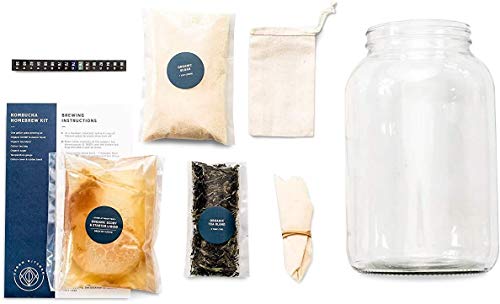
- Includes one-gallon glass jar and organic SCOBY
- Comes with tea, cane sugar, starter liquid, and tools
- Wide-mouth jar with instructions and temperature gauge
Best For: First-time brewers wanting an all-in-one setup
Best Two-Jar Value

- Provides two one-gallon glass jars
- Spigots make dispensing more convenient
- Includes covers and six temperature strips
Best For: Brewers who want two vessels for rotating batches
Best Accessory Bundle
Stainless Steel Filter Jar Kit

- One-gallon fermenter with stainless steel filter
- Includes spigot, thermometer, test paper, and tools
- SCOBY is not included
Best For: Brewers who want filtration and batch-tracking accessories
Best Starter Kit – 1-Gallon Wide-Mouth Kombucha Jar
For beginners comparing kombucha jars for beginners, this 1-gallon wide-mouth glass jar offers a straightforward setup for brewing, stirring, and cleaning. It includes a breathable cotton cloth cover, securing rubber band, and airtight plastic lid for storage.
Best For: First-time brewers who want a complete, single-jar setup.
Pros:
- Wide mouth makes filling, stirring, and cleaning easier.
- Includes the jar, cotton cloth cover, rubber band, and plastic lid.
- Dishwasher-safe glass and BPA-free materials are practical for routine use.
- Can also support sourdough starters and other fermentation projects.
Cons:
- Only one jar is included.
- Its 1-gallon capacity may not suit larger batches.
This is a well-rounded entry point for beginners who want the essential brewing accessories in one package without adding a separate dispenser or specialty hardware.
Best for Continuous Brewing – 5-Liter Kombucha Jar with Spigot
Among kombucha jars for beginners, this 5-liter glass jar is designed for continuous brewing rather than one-off batches. Its spigot lets you dispense kombucha while keeping the brewing cycle moving, and the breathable stainless steel mesh top helps protect the brew from contaminants.
Best For: Beginners who plan to make and dispense kombucha regularly.
Pros:
- Spigot supports convenient dispensing and continuous brewing.
- 1.3-gallon capacity leaves room for ongoing batches.
- Glass is described as nonreactive and resistant to scratching.
- Stainless steel mesh top allows airflow while helping keep out fruit flies.
Cons:
- Continuous brewing requires maintaining a portion of the previous batch.
- Cleaning instructions call for lukewarm water rather than hot water.
- Its larger, spigot-equipped design may be more setup than occasional brewers need.
The spigot makes this a convenient choice for daily servings, while the continuous-brew format is best for users ready to establish a regular kombucha routine.
Best Budget Jar – 1-Gallon Wide-Mouth Glass Jar
This wide-mouth gallon jar is a simple option for shoppers seeking kombucha jars for beginners without a bundled cloth filter or fermentation accessories. The food-grade glass works for kombucha, pickling, canning, and dry storage, and the broad opening makes large-batch handling easier.
Best For: Beginners who already have a breathable cover or want a versatile utility jar.
Pros:
- Wide mouth provides easier access for filling, emptying, and cleaning.
- Suitable for kombucha, pickling, canning, and other fermentation projects.
- Reusable food-grade glass can also store dry goods.
- Manufactured in the United States.
Cons:
- Does not include a cloth cover or rubber band for fermentation.
- Hand washing is listed in the care instructions, despite an additional dishwasher-safe note.
- Only one jar is included.
This is a practical blank-slate jar: a good fit for experienced DIY shoppers or beginners who want to choose their own cover and use the container beyond kombucha.
Best Two-Jar Set – Two 1-Gallon Kombucha Jars
For beginners comparing kombucha jars for beginners, this two-jar set provides extra capacity for alternating batches or expanding a fermentation setup. Each jar includes a breathable muslin cover, rubber band, plastic lid, and adhesive temperature strip.
Best For: New brewers who want two vessels for multiple batches or different fermented foods.
Pros:
- Includes two 1-gallon glass jars and matching fermentation accessories.
- Breathable covers and rubber bands help convert the jars into fermentation vessels.
- Adhesive temperature strips help monitor batch temperature.
- Can also be used for kefir, sauerkraut, and pantry organization.
Cons:
- The two-jar set requires more storage space.
- The listed package details contain some quantity inconsistencies.
- It does not include a dispensing spigot.
The pair offers useful flexibility for beginners who want to keep a batch going while starting another, or who plan to explore several fermentation projects.
Heavy-Duty Brewing Duo – Twin 1-Gallon Airlock Jars
For beginners comparing kombucha jars for beginners, this two-pack offers a sturdy, roomy setup with fermentation airlocks already included. The wide-mouth, 1-gallon glass jars are designed for brewing and can also handle other fermentation or bulk-storage tasks.
Best For: Beginners who want two large jars for kombucha and other fermentation projects.
Pros:
- Includes two 1-gallon wide-mouth glass jars, BPA-free lids, and Econolock airlocks.
- Thicker, heavier food-grade glass provides added stability during fermentation.
- Airlocks let gases escape while helping limit outside air and contaminants.
- Wide mouths make filling and cleaning more convenient.
Cons:
- Hand washing is recommended despite the food-grade, dishwasher-safe material listing.
- The larger capacity may be more than a beginner needs for small experimental batches.
This is a practical choice if you want a durable, reusable setup and plan to brew regularly. The included airlocks make it more fermentation-focused than a basic storage jar, while the two-jar format supports batch rotation.
Complete Starter Pick – Organic SCOBY Kombucha Kit
If you are new to kombucha jars for beginners, this kit bundles the main supplies needed to start brewing at home. Along with a 1-gallon glass jar, it includes an organic SCOBY, breathable cover, thermometer, pH strips, and instructions for the first fermentation.
Best For: First-time brewers who want a guided starter kit rather than a jar alone.
Pros:
- Includes a 1-gallon plain glass brewing jar, muslin cover, and rubber band.
- Comes with a USDA Certified Organic Kombucha SCOBY.
- pH strips and an adhesive thermometer provide useful brewing checks.
- Step-by-step instructions are included for getting started.
Cons:
- This is a stripped-down kit, so it may not include extras beyond the listed components.
- The breathable-cover design is intended for initial brewing rather than an airlocked setup.
Among beginner-focused options, this kit stands out because it combines the culture and basic monitoring tools with the vessel. It is a convenient entry point for learning the process without sourcing each component separately.
Small-Batch Choice – Two 1/2-Gallon Airlock Jars
For shoppers seeking kombucha jars for beginners without committing to a full gallon, this two-pack provides a smaller-batch format. Each wide-mouth glass jar has a fermentation lid and airlock, making the set useful for kombucha as well as pickles, sourdough starter, and other projects.
Best For: Beginners who prefer smaller batches or want two jars for testing different brews.
Pros:
- Includes two 1/2-gallon reusable food-grade glass jars.
- Fermentation lids, grommets, stoppers, and airlocks are included.
- Wide mouths simplify filling and cleaning.
- Dishwasher-safe glass can also be used for dry-food storage.
Cons:
- The 1/2-gallon capacity is smaller than a standard 1-gallon brewing jar.
- The supplied notes do not list a SCOBY, starter liquid, or pH-testing supplies.
This set makes sense when flexibility and batch size matter more than an all-in-one starter package. Its two-jar design can support separate experiments, while the included airlocks keep the setup ready for fermentation.
Best with Extra Features – Organic SCOBY Kombucha Kit
For beginners searching for kombucha jars for beginners, this kit is a convenient starting point because it includes the one-gallon glass jar along with the ingredients and basic tools needed for a first batch. The wide-mouth, thick-walled jar is paired with an organic SCOBY, starter liquid, tea, sugar, cover, and temperature gauge.
Best For: First-time brewers who want an all-in-one kit with a SCOBY and brewing ingredients included.
Pros:
- Includes an organic SCOBY, starter liquid, tea, cane sugar, jar cover, and temperature gauge.
- Wide-mouth, thick-walled glass jar holds one gallon.
- Includes instructions and reusable tea bag for a simpler setup.
- Starter liquid and SCOBY can support future one-gallon batches.
Cons:
- Only one jar is included, so it is not a two-vessel setup.
- The kit’s included organic tea and cane sugar may not suit every preferred recipe.
This is the most beginner-focused option of the three: it combines the jar with the fermentation essentials, reducing the need to source a SCOBY and ingredients separately.
Best Two-Jar Value – 2-Pack Continuous Brewing Kit
If you want kombucha jars for beginners but prefer extra capacity for rotating batches, this two-pack provides two one-gallon glass jars with spigots, covers, and temperature strips. The wide openings make filling and cleaning more convenient, while the dispensing valves are designed to reduce mess when serving.
Best For: Beginners or households that want two one-gallon vessels for experimenting with batches or continuous brewing.
Pros:
- Includes two one-gallon glass brewing jars.
- Plastic spigots support convenient dispensing.
- Wide-mouth openings simplify pouring and cleaning.
- Includes two elastic cloth covers and six adhesive temperature strips.
Cons:
- SCOBY, tea, sugar, and starter liquid are not listed as included.
- The temperature strips are disposable.
- Glass may be vulnerable to damage during shipping, according to the product notes.
Choose this kit when the jars themselves are your priority. It offers useful hardware and redundancy, but you will need to supply the fermentation ingredients separately.
Best Accessory Bundle – Stainless Steel Filter Jar Kit
For beginners comparing kombucha jars for beginners, this one-gallon kit stands out for its broad accessory bundle. It includes a glass fermenter with stainless steel spigot, lid, and mesh filter, plus a measuring cup, thermometer, test paper, cloth top, brush, and markers for tracking batches.
Best For: Home brewers who already have a SCOBY and want an accessory-heavy jar setup for customized recipes.
Pros:
- Includes a one-gallon fermenter with stainless steel spigot and mesh filter.
- Comes with thermometer, test paper, measuring cup, brush, markers, and cloth top.
- Mesh filter is designed to help strain tea leaves and add fruits or spices.
- Printed notes area supports batch tracking.
Cons:
- SCOBY is not included.
- Ingredients such as tea, sugar, and starter liquid are not listed as included.
This is a practical choice for ingredient-ready beginners or experienced brewers who value filtration and record-keeping features. Confirm that the included accessories match your preferred brewing routine before buying.
How We Picked the Best Kombucha Jars for Beginners
We focused on the features that make first-time brewing more manageable: food-safe glass construction, useful capacity, wide openings for adding tea and removing the SCOBY, and covers that allow airflow while helping keep out dust and insects. We also considered whether each option includes practical extras such as rubber bands, pH strips, temperature gauges, starter tea, a SCOBY, a spigot, or fermentation hardware.
Because starter kits vary substantially, check the exact package contents before buying. Some products are simply empty brewing vessels, while others are designed to let you begin fermenting immediately.
Quick Comparison
| Type | Best for | Typical advantage |
|---|---|---|
| Basic wide-mouth jar | First-time brewers on a budget | Simple setup and easy cleaning |
| Two-jar pack | Brewing multiple batches | Extra capacity or batch rotation |
| Starter kit | New brewers who need supplies | May include SCOBY, starter liquid, and tools |
| Spigot jar | Frequent drinkers | Convenient sampling and dispensing |
| Continuous-brew system | Ongoing production | Designed for repeated draws and refills |
Key Buying Factors for Kombucha Jars for Beginners
Capacity and Counter Space
A one-gallon jar is a common starting point because it provides enough finished kombucha for regular use without taking over the counter. Half-gallon jars can suit smaller households or beginners who want shorter, easier-to-manage batches. Measure the available space, including clearance for the cover and access around any spigot.
Opening, Cover, and Cleaning
Wide-mouth designs are generally easier to fill, inspect, clean, and use with larger SCOBYs. Look for a breathable cloth cover secured with a firm band. Avoid sealing the vessel airtight during the primary fermentation stage, since kombucha needs airflow and fermentation produces carbon dioxide.
Spigots and Fermentation Accessories
A spigot is convenient for tasting or dispensing without disturbing the SCOBY, but it adds another component to clean and inspect for leaks. If choosing a continuous-brew jar, confirm that the tap is positioned usefully and that replacement parts or seals are available. Airlocks are more specialized and may not be necessary for a basic first batch.
What Comes in the Kit
For the simplest start, choose a kit that clearly includes a healthy SCOBY, starter liquid, tea, sugar, and instructions. If you already have these supplies, an empty jar and breathable cover may offer better value. pH strips and temperature tools are helpful for monitoring, but they do not replace clean equipment and careful fermentation practices.
Who Should Buy Which Kombucha Jars for Beginners?
Choose a basic wide-mouth gallon jar if you want the lowest-cost, easiest-to-clean setup. Select a two-pack if you plan to maintain separate batches, experiment with flavors, or keep one jar available while another is in use. A complete starter kit is the better choice when you do not already own a SCOBY or brewing supplies.
Frequent kombucha drinkers should consider a spigot or continuous-brew model for easier serving. Smaller households may prefer half-gallon jars, while anyone prioritizing simplicity should avoid paying for specialized hardware they are unlikely to use. Whatever you choose, verify the glass is intended for food use, inspect accessories before brewing, and follow reliable sanitation and fermentation guidance.
