The best meat slicers for beginners make it easier to prepare deli meat, roast beef, hot-pot cuts, cheese, vegetables, and bread with consistent thickness. The right model should be simple to control, stable on the counter, and straightforward to clean.
This roundup compares 10 electric and manual slicers across blade size, adjustment range, power, handling, and intended use. Whether you want occasional home slicing or a more capable machine for frequent meal prep, these options cover the main beginner-friendly choices.
Best 10 Meat Slicers for Beginners Picks for 2026
Quiet Motor Pick

- 200W lower-noise motor
- 0–15 mm thickness adjustment
- Two removable 7.5-inch blades
Best For: Home cooks seeking versatile electric slicing and easy disassembly
Compact Electric Pick

- 200W motor with 70–100 RPM operation
- 0–15 mm adjustable thickness
- Removable cleaning components
Best For: Space-conscious beginners slicing meats and everyday foods
Manual Budget Pick

- Manual, electricity-free operation
- 0.2–20 mm thickness range
- Includes extra blade and meat holder
Best For: Cooks slicing properly frozen meat on a budget
Dual-Blade Upgrade
VEVOR 8.6-Inch Electric Slicer

- 8.6-inch serrated and smooth blades
- 200W motor with 0–15 mm adjustment
- Dual security lock and suction feet
Best For: Beginners wanting broader cutting flexibility at home
Best Fresh-Meat Starter
SupMaKin 17-in-1 Manual Slicer

- Makes 18 slices in one stroke
- Offers 2 mm and 4 mm settings
- Compact, suction-stabilized design
Best For: Fresh-meat prep for hot pot, jerky, and sushi
Best Beginner Electric Option
VEVOR 7.5-Inch Electric Slicer

- 200W motor reduces manual effort
- Adjusts from 0 to 15 mm
- Includes serrated and smooth blades
Best For: Home cooks slicing meat, bread, and vegetables
Best Manual Frozen-Meat Pick

- Handles frozen meat and vegetables
- Adjusts from 0.25 mm to 25 mm
- Uses suction cups for stability
Best For: Manual hot-pot and frozen-meat preparation
Best with Extra Features

- 200W automatic operation
- 0–15 mm adjustable thickness
- Removable blade and carriage
Best For: Home cooks slicing meat, deli foods, and bread
Best Manual Value
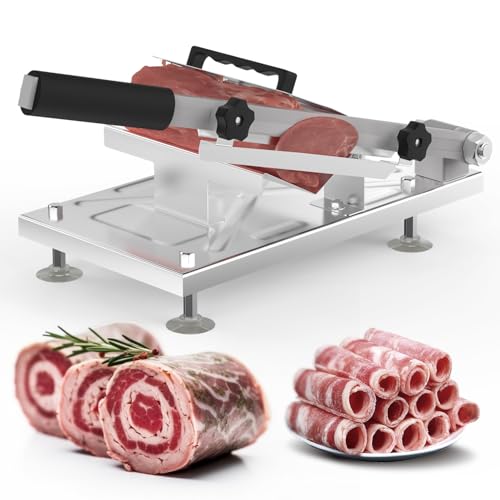
- 0.2–20 mm thickness range
- Stainless steel manual design
- Includes spare blade and accessories
Best For: Frozen-meat preparation for hot pot, BBQ, and sandwiches
Best Heavy-Duty Option
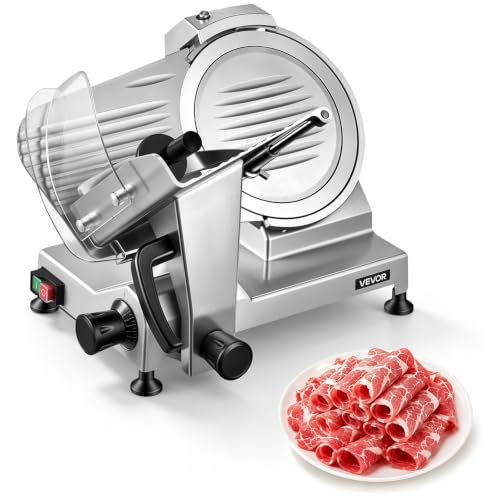
- 240W semi-automatic motor
- 10-inch carbon-steel blade
- 0–12 mm adjustable thickness
Best For: Frequent home or commercial slicing of varied meats
Quiet Motor Pick – 200W Home Food Slicer
For beginners comparing meat slicers for beginners, this 200W home model offers straightforward thickness control, two blade styles, and a removable design for routine kitchen prep. Its 0–15 mm adjustment range also makes it useful for cheese, vegetables, and bread.
Best For: Home cooks who want an electric slicer with versatile blades and simple cleanup.
Pros:
- 200W DC motor is designed for stable, lower-noise operation.
- Adjustable thickness from 0 to 15 mm supports thin or thicker slices.
- Includes serrated and non-serrated 7.5-inch stainless steel blades.
- Removable blades and tray simplify hand washing.
Cons:
- Product care instructions specify hand washing.
- Its 7.5-inch blades may be less suitable for larger cuts than longer-blade models.
This is a practical entry point for beginners who value quiet operation, flexible slicing, and built-in safety features such as a child lock and non-slip feet.
Compact Electric Pick – VEVOR 7.5-Inch Deli Slicer
This VEVOR model is a compact option for beginners shopping for meat slicers for beginners. The 200W motor, simple thickness knob, and food pusher make everyday slicing more controlled, while the removable parts help keep cleanup manageable.
Best For: Beginners who want a compact electric slicer for meat, bread, vegetables, and deli-style foods.
Pros:
- 200W motor operates at 70–100 RPM for efficient slicing.
- Thickness adjusts from 0 to 15 mm with a simple knob.
- Removable blade, food pusher, and slide bar support thorough cleaning.
- Suction-cup feet and a food pusher promote stable, safer use.
Cons:
- Includes one serrated blade rather than dual blade styles.
- Hand washing is required according to the care instructions.
With its relatively light 7.9-pound build and compact footprint, this semi-automatic slicer suits kitchens where storage space and uncomplicated controls matter.
Manual Budget Pick – Befen Frozen Meat Slicer
For beginners who prefer a hands-on approach, this manual Befen cutter is one of the simplest meat slicers for beginners. It is designed for properly frozen beef, lamb, chicken, ham, and fish, with a wide 0.2–20 mm adjustment range for hotpot, stir-fry, barbecue, and sandwich preparation.
Best For: Budget-conscious cooks who mainly slice properly frozen meat without using electricity.
Pros:
- Manual operation avoids a motor and electrical controls.
- Adjusts from very thin 0.2 mm slices up to 20 mm.
- Thick stainless steel construction is intended for repeated home use.
- Includes an extra blade, meat holder, bags, suction cups, and hex key.
Cons:
- Meat must be properly frozen for clean cuts.
- Manual slicing requires more physical effort than an electric model.
- Designed primarily for meat rather than a broad range of foods.
This is a focused choice for home cooks who regularly prepare frozen meat and are comfortable following the preparation and operating instructions.
Dual-Blade Upgrade – VEVOR 8.6-Inch Electric Slicer
This larger VEVOR model gives beginners shopping for meat slicers for beginners more blade flexibility without complicated controls. Its 8.6-inch blade size, 200W motor, and 0–15 mm thickness knob support consistent slicing across frozen meat, deli foods, bread, and vegetables.
Best For: Home cooks who want an electric slicer with both serrated and non-serrated blades.
Pros:
- Includes 8.6-inch serrated and non-serrated stainless steel blades.
- Adjustable thickness from 0 to 15 mm handles varied slicing preferences.
- Removable blade, pusher, and slide bar make cleaning easier.
- Dual security lock and suction-cup feet support stable operation.
Cons:
- At 14 pounds, it is heavier than the smaller VEVOR model.
- Its larger dimensions require more storage space.
- Care instructions call for hand washing.
The dual-blade setup makes this a strong all-around option when beginners want to switch between serrated and smooth cutting without giving up adjustable thickness control.
Best Fresh-Meat Starter – SupMaKin 17-in-1 Manual Slicer
For beginners comparing meat slicers for beginners, the SupMaKin is a straightforward manual option for fresh meat. Its 17-blade setup can produce 18 slices in one stroke, while interchangeable blade sets provide 2 mm or 4 mm cuts for hot pot, jerky, sushi, strips, and dices.
Best For: Home cooks slicing fresh pork, beef, chicken breast, or salmon—not frozen or deli meat.
Pros:
- Creates 18 slices in one stroke with its 17-blade design.
- Offers 2 mm and 4 mm thickness options.
- Stainless steel blades, suction-cup stability, cleaning brush, and compact storage design.
Cons:
- Not intended for frozen or deli meat.
- Requires hand washing.
- Manual operation may require more effort than an electric slicer.
This is a good entry-level pick when your main goal is portioning fresh meat efficiently. The limited thickness range is less flexible than some slicers, but the compact design and included cleaning brush make it approachable for home use.
Best Beginner Electric Option – VEVOR 7.5-Inch Electric Slicer
Among meat slicers for beginners, the VEVOR stands out for reducing manual effort with a 200W motor and semi-automatic operation. Its thickness knob adjusts from 0 to 15 mm, and the included serrated and non-serrated blades cover foods ranging from frozen meat and deli items to bread and vegetables.
Best For: Beginners who want powered slicing and broad food versatility in a home kitchen.
Pros:
- 200W motor operates at 70–100 RPM for efficient slicing.
- Includes both serrated and non-serrated 7.5-inch stainless steel blades.
- Removable blade, pusher, and slide bar support easier cleaning.
- Food pusher and suction-cup feet add stability during use.
Cons:
- Heavier and larger than compact manual options at 8.4 pounds.
- Components require hand washing.
- Electric operation adds more parts and setup than a basic manual slicer.
The VEVOR is the most flexible choice here for beginners who expect to slice different foods regularly. Its adjustable range and two blades are useful, while the removable components make routine cleanup more manageable.
Best Manual Frozen-Meat Pick – Adjustable Frozen Meat Slicer
For beginners seeking meat slicers for beginners that can handle frozen cuts, this manual stainless steel slicer offers a broad 0.25 mm to 25 mm adjustment range. Its ergonomic handle, meat press cover, sharp alloy steel blade, and four suction cups are designed to make home slicing more controlled.
Best For: Home cooks preparing frozen beef, lamb, ham, vegetables, and hot-pot ingredients.
Pros:
- Designed to slice frozen meat as well as vegetables.
- Provides a wide adjustable thickness range from 0.25 mm to 25 mm.
- Four suction cups and a non-slip meat press cover support stability.
- Dishwasher-safe construction simplifies cleanup.
Cons:
- Manual slicing can require more physical effort.
- The supplied dimensions and product details are limited.
- Removing the baffle for ribs and other meats adds an extra setup step.
This model is a practical fit if frozen-meat slicing is your priority and you want maximum thickness flexibility without an electric motor. Its stability features are helpful for new users, though manual operation remains more hands-on.
Best with Extra Features – Nutrichef 200W Meat Slicer
For beginners searching for meat slicers for beginners, the Nutrichef offers straightforward electric operation, a 200W motor, and an adjustable 0–15 mm thickness dial. Its compact size and removable food-contact parts make it a practical option for home use.
Best For: Home cooks who want an easy-to-operate electric slicer for meat, deli foods, and bread.
Pros:
- Automatic operation with a simple on-off switch
- Adjustable thickness up to 15 mm
- Removable blade and carriage support cleaning
- Safety guard, food pusher, and compact dimensions
Cons:
- Hand wash only
- Its 7.5-inch blade and 15 mm range may be limiting for larger jobs
The Nutrichef is a beginner-friendly choice when convenience and compact storage matter most. It provides useful thickness control without the heavier footprint of a commercial slicer.
Best Manual Value – Adjustable Frozen Meat Slicer
This manual model is a useful introduction to meat slicers for beginners who mainly prepare frozen meat for hot pot, BBQ, shabu shabu, or sandwiches. It has an adjustable 0.2–20 mm range and includes accessories to help get started.
Best For: Home cooks who want thin, customizable slices of properly frozen beef, pork, mutton, ham, or fish without using an electric motor.
Pros:
- Wide 0.2–20 mm thickness adjustment
- Thickened 1.5 mm stainless steel construction
- Includes a spare blade, food bags, meat holder, suction cups, and tools
- Manual design requires no electrical connection
Cons:
- Requires meat to be properly frozen for best results
- Manual operation takes more effort than an electric slicer
- Hand wash only
Its broad adjustment range and included accessories make this a flexible option for beginners focused on frozen-meat preparation. Expect more hands-on work, but no motor or electrical controls to manage.
Best Heavy-Duty Option – VEVOR 10-Inch Electric Slicer
Beginners who need more capacity may prefer the VEVOR commercial slicer over smaller meat slicers for beginners. Its 240W motor, 10-inch carbon-steel blade, and semi-automatic design are suited to frequent slicing at home or in commercial settings.
Best For: Users who need to slice frozen, raw, or cooked meats and ham efficiently and have room for a heavier countertop machine.
Pros:
- Large 10-inch blade with a 0–12 mm thickness range
- 240W load power and 350–400 rpm operating speed
- Built-in sharpening stone helps maintain blade sharpness
- Removable food-contact parts and food pusher
Cons:
- Heavy 34-pound construction and large footprint
- Semi-automatic operation may require more attention than a compact automatic model
- Hand wash only
The VEVOR offers greater cutting capacity and stability than compact home slicers, but its commercial-style size and weight make it less convenient to store. It is best for beginners who expect frequent, higher-volume use.
How We Picked the Best Meat Slicers for Beginners
We focused on the features that matter most when learning to slice at home: ease of operation, cutting control, stability, cleanup, and versatility. The selection includes compact electric slicers for deli meat and bread, manual cutters designed for partially frozen meat, and larger machines for users who expect heavier workloads.
We also considered blade diameter, available thickness settings, removable components, food-contact materials, safety features, and whether each slicer is better suited to occasional preparation or repeated use. Product specifications can vary by listing, so confirm the included blades, dimensions, and accessories before ordering.
Quick Comparison
| Type | Best for | Main advantage | Potential limitation |
|---|---|---|---|
| Compact electric slicer | Deli meat, cheese, bread | Fast and consistent cuts | May have a smaller cutting capacity |
| Larger electric slicer | Frequent slicing and larger roasts | More capacity and power | Uses more counter and storage space |
| Manual frozen-meat slicer | Hot pot, shabu-shabu, and thin meat | No motor or electricity required | Requires more effort and careful technique |
| Adjustable specialty slicer | Users who want specific thicknesses | Greater control over portions | May take longer to set up and clean |
Key Buying Factors for Meat Slicers for Beginners
Electric or Manual Operation
Electric models are usually the easiest starting point for slicing cooked meat, deli foods, cheese, and bread. Manual cutters can be useful for very thin hot-pot slices and do not require a motor, but they demand steady pressure and proper hand placement. Beginners should choose manual equipment only if they are comfortable working with partially frozen food and following the safety instructions.
Blade Size and Cutting Capacity
A 7.5-inch blade is often adequate for typical home portions. An 8.6-inch or 10-inch blade can handle larger items more comfortably, but the machine will generally be heavier and require more storage space. Match the blade and carriage size to the foods you actually prepare rather than choosing the largest option automatically.
Thickness Adjustment and Control
Look for a clearly marked adjustment dial or guide. A broad range, such as thin deli slices through thicker cuts, adds versatility, while fixed or limited settings can be simpler for a single use case. Consistent results also depend on allowing cooked meat to chill or partially freezing raw meat as directed.
Safety and Cleaning
Prioritize non-slip feet, a food pusher or guard, covered controls, and components that are easy to remove. Never reach toward a moving blade, and unplug electric slicers before cleaning. Wash food-contact parts promptly according to the manufacturer’s instructions; do not assume every component is dishwasher-safe.
Who Should Buy Which Meat Slicers for Beginners?
Choose a compact electric slicer if you want the easiest all-around option for sandwiches, cheese, bread, and occasional meal prep. Select a larger electric model if you regularly slice bigger roasts or need faster preparation for a household or gathering. A manual stainless-steel cutter is the better fit for hot-pot and shabu-shabu enthusiasts who value thin slices and do not mind extra effort. If precise portion control is your priority, focus on a model with a clearly labeled, wide-ranging thickness adjustment.
Before buying, check available counter space, storage requirements, replacement-blade availability, warranty coverage, and the manufacturer’s cleaning guidance. Those practical details often matter more to a beginner than maximum motor power alone.
