Preparing deli meat, jerky, cheese, or bread for a crowd is faster and more consistent with the right slicer. The best meat slicers for large batches combine dependable motors, sharp blades, adjustable thickness controls, and easy cleanup.
We compared 10 electric and manual models across blade size, power, capacity, construction, safety, and maintenance features to help you choose a slicer that matches your workload.
Best 10 Meat Slicers for Large Batches Picks for 2026
Heavy-Duty Workhorse
10NS Commercial 10-Inch Electric Meat Slicer
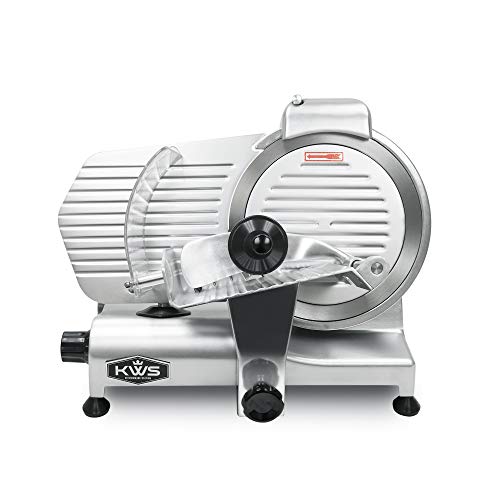
- 320W motor for repeated slicing
- 10-inch NSF-certified stainless steel blade
- Adjustable cuts up to 14 mm
Best For: Bulk prep, game meat, cheese, and light commercial use
Quiet Everyday Prep

- Quiet 200W DC motor
- Two removable 7.5-inch blades
- 0–15 mm thickness adjustment
Best For: Moderate home batches of meat, cheese, vegetables, and bread
Jerky Batch Specialist
Weston Manual Beef Jerky Slicer

- 32 stainless steel slicing blades
- Cuts up to 15 quarter-inch strips at once
- Handles meat up to 5 inches wide
Best For: Large-batch homemade jerky and game-meat processing
Maximum Blade Capacity
VEVOR 12-Inch Commercial Meat Slicer

- 12-inch carbon steel blade
- 320W motor with 0–15 mm adjustment
- Heavy aluminum body with safety features
Best For: High-volume prep and restaurant-style slicing
Fast-Batch Flexibility
OSTBA 200W Electric Meat Slicer

- 200W motor for frozen meat and dense foods
- Two 7.5-inch interchangeable stainless steel blades
- 0–15mm adjustment and removable parts
Best For: Home batch prep across meat, cheese, bread, and produce
Stable Larger-Cut Performance

- 200W motor operates at 70–100 RPM
- 8.6-inch dual stainless steel blades
- 0–15mm adjustment with security locks
Best For: Home cooks handling frequent, varied slicing jobs
Commercial-Style Capacity
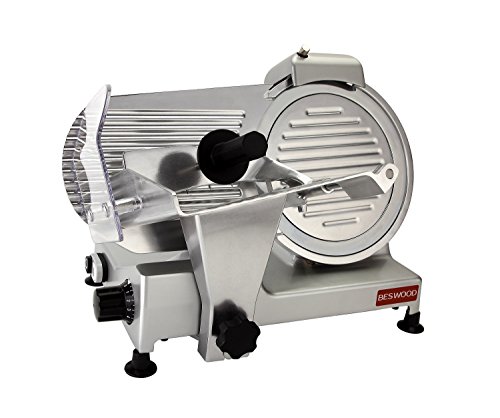
- 240W motor with a 10-inch blade
- Corrosion-resistant chromium-plated steel blade
- Heavy 33-pound aluminum-and-steel construction
Best For: Large recurring workloads in home or commercial settings
Compact Batch Helper

- 0–15mm adjustable thickness
- Removable blade and carriage
- Compact 13.9-inch footprint
Best For: Home cooks needing a space-conscious slicer for repeated meal prep
Heavy-Duty Batch Pick
VEVOR 10-Inch Commercial Slicer
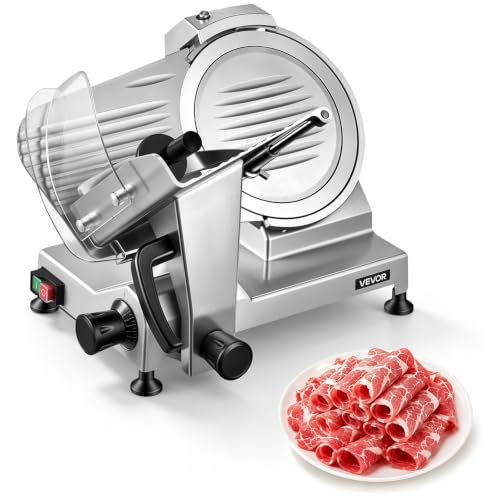
- 10-inch carbon steel blade
- 240W load power and 350–400 rpm
- 0–12mm thickness adjustment
Best For: High-volume prep requiring a larger blade and sturdier commercial-style build
Versatile Family Prep
CUSIMAX 200W Dual-Blade Slicer

- Two removable 8.7-inch blades
- 1–20mm adjustable thickness
- Removable food-contact components
Best For: Home cooks slicing meats, cheese, bread, produce, and other varied foods
Heavy-Duty Workhorse – 10NS Commercial 10-Inch Electric Meat Slicer
For shoppers comparing meat slicers for large batches, the 10NS stands out with a 320W high-torque motor, a 10-inch stainless steel blade, and a large food tray. Its adjustable thickness control supports paper-thin slices through cuts up to 14 mm, making it suited to repeated home or light-commercial prep.
Best For: Bulk meat, cheese, semi-frozen food, jerky preparation, game processing, and small food-service operations.
Pros:
- 320W belt-driven motor is designed for continuous slicing.
- Adjustable thickness control reaches up to 14 mm.
- Removable carriage, blade, blade cover, and hand guard simplify cleanup.
- Built-in dual whetstones help maintain the NSF-certified stainless steel blade.
Cons:
- Its larger, heavier-duty construction may be more than occasional users need.
- The optional bread-slicing attachment is sold separately.
- Ultra-thin slicing works best when meat is partially frozen first.
Choose this model when batch capacity, steady motor performance, and serviceable construction matter more than a compact, occasional-use design. Its safety listings, removable components, and available replacement support add practical value for frequent prep.
Quiet Everyday Prep – 200W Home Meat Slicer
For meat slicers for large batches in a home kitchen, this 200W model offers a practical balance of capacity and convenience. It includes two 7.5-inch stainless steel blades, adjustable thickness from 0 to 15 mm, and a detachable design intended to make routine cleaning easier.
Best For: Home users slicing meat, cheese, vegetables, and bread in moderate batches.
Pros:
- 200W DC motor is designed for stable, lower-noise operation.
- Two removable blades provide serrated and non-serrated options.
- 0–15 mm thickness adjustment supports both thin and thicker slices.
- Child safety lock, blade cover, and non-slip feet support safer operation.
Cons:
- Its 7.5-inch blades and 200W motor are less substantial than commercial-style alternatives.
- Hand washing is required according to the care instructions.
- The product is positioned for home use rather than demanding commercial workloads.
This is a sensible choice for shoppers who want batch-friendly features without moving to a full commercial slicer. The interchangeable blades and broad thickness range make it versatile, while the detachable tray and blades help with cleanup.
Jerky Batch Specialist – Weston Manual Beef Jerky Slicer
Among meat slicers for large batches, this Weston model is specialized for quickly turning sizable cuts into uniform jerky strips. Its 32 stainless steel blades can produce up to 15 quarter-inch strips at once, without relying on an electric motor.
Best For: Homemade jerky from beef, game meat, turkey, and duck breast.
Pros:
- Produces consistent 0.25-inch strips in batches of up to 15 at once.
- Large chute accepts meat up to 5 inches wide and 1.25 inches thick.
- Built-in C-clamp mounts to flat surfaces up to 2 inches thick.
- Includes stainless steel combs and tongs to help feed and handle meat.
Cons:
- It is a manual slicer, so operation requires physical effort.
- Its fixed jerky-strip format is less versatile than an adjustable electric slicer.
- It requires a suitable table or counter edge for clamping.
If your large-batch prep is primarily jerky, this focused design can be more efficient than a general-purpose slicer. It is especially useful for processing large cuts, but shoppers wanting variable thickness or deli-style slices should consider an electric model instead.
Maximum Blade Capacity – VEVOR 12-Inch Commercial Meat Slicer
For demanding meat slicers for large batches, this VEVOR model combines a 12-inch carbon steel blade with a 320W motor and a substantial aluminum-alloy body. Its 0–15 mm thickness adjustment is designed for deli-style cuts ranging from very thin to thicker portions.
Best For: High-volume home prep, restaurant-style slicing, and users who need a large blade for meat, cheese, vegetables, and semi-frozen foods.
Pros:
- Large 12-inch carbon steel blade handles substantial slicing tasks.
- Built-in sharpening stone supports convenient blade maintenance.
- Adjustable thickness ranges from 0 to 15 mm.
- Safety guard, transparent baffle, waterproof switch, and rubber feet promote stable operation.
Cons:
- At 46.3 pounds, it is substantially heavier and less portable than home models.
- The 21.6-by-17.7-by-16.5-inch footprint requires considerable counter space.
- Hand washing is specified for product care.
This is the strongest fit here for shoppers prioritizing blade size and commercial-style stability. Its weight and footprint are trade-offs, but they make sense when frequent, larger-volume slicing is more important than easy storage.
Fast-Batch Flexibility – OSTBA 200W Electric Meat Slicer
For shoppers comparing meat slicers for large batches, the OSTBA combines a 200W motor with two interchangeable 7.5-inch blades and adjustable thickness control. It is suited to processing meat, cheese, bread, and produce while remaining relatively compact for home-kitchen use.
Best For: Home cooks who want versatile slicing and easy cleanup for recurring batch-prep tasks.
Pros:
- 200W motor is designed to handle frozen meat and dense deli foods.
- Includes serrated and non-serrated stainless steel blades for different ingredients.
- Adjusts from 0 to 15mm and has removable components for cleaning.
- Safety lock, food pusher, and suction feet support more secure operation.
Cons:
- Its 7.5-inch blade is smaller than the blades on the other slicers in this roundup.
- Dishwasher-safe components are convenient, but the product’s semi-automatic operation still requires hands-on feeding.
The OSTBA is a practical choice when flexibility and straightforward maintenance matter more than commercial-scale capacity. Its dual-blade setup and 0–15mm range make it adaptable for mixed batch jobs.
Stable Larger-Cut Performance – VEVOR 8.6-Inch Meat Slicer
The VEVOR is a strong candidate among meat slicers for large batches, with a 200W motor, an 8.6-inch blade, and operating speeds of 70–100 RPM. Its larger cutting surface and dual-blade design are useful for preparing deli meats, frozen foods, bread, and vegetables in consistent portions.
Best For: Home users who prioritize a larger blade, stable countertop operation, and adjustable slices.
Pros:
- 8.6-inch stainless steel blades provide a larger cutting surface than compact models.
- Includes serrated and non-serrated blades for frozen meat, deli items, steak, ham, and more.
- Thickness adjusts from 0 to 15mm with a simple control knob.
- Dual security locks, a food pusher, and suction feet add stability and protection.
Cons:
- At 14 pounds, it is less lightweight than smaller home slicers.
- Care instructions specify hand washing rather than dishwasher cleaning.
With its larger blade and stable base, the VEVOR is well matched to repeated home slicing sessions. It offers useful batch-prep capacity without claiming the construction or workflow of a fully commercial slicer.
Commercial-Style Capacity – BESWOOD 10-Inch Meat Slicer
For demanding meat slicers for large batches, the BESWOOD250 stands out with a 10-inch chromium-plated steel blade and a 240W electric motor. Its larger, 33-pound aluminum-and-steel build is intended for precise slicing of meat, cheese, vegetables, ham, and fruit in home or commercial settings.
Best For: Users who need a heavier, commercial-oriented slicer for substantial recurring workloads.
Pros:
- 10-inch chromium-plated steel blade is corrosion-resistant and does not require frequent sharpening.
- 240W motor supports substantial slicing work.
- Heavy 33-pound construction can provide a stable working platform.
- ETL listed and certified, with an illuminated 24V ON/OFF switch for added protection.
Cons:
- Its 33-pound weight and 20-by-17-by-14.75-inch dimensions make it difficult to move or store.
- Hand-wash-only care requires more cleanup effort.
- The supplied details do not specify an adjustable thickness range.
The BESWOOD250 is the most substantial option here for shoppers who value blade size and machine stability over portability. It makes the most sense when the slicer can remain set up and handle frequent, larger-volume sessions.
Compact Batch Helper – Nutrichef 200W Meat Slicer
For home cooks who need meat slicers for large batches without giving up valuable counter space, the Nutrichef offers a compact automatic design, 200W of power, and thickness control from 0 to 15mm. Its removable blade and food carriage also help simplify cleanup after preparing deli meats, bread, or other foods.
Best For: Home kitchens that want a compact slicer for repeated meal prep and moderate-size batches.
Pros:
- Adjustable 0–15mm slicing range supports thin deli cuts through thicker portions.
- Removable 7.5-inch stainless steel blade and detachable carriage make cleaning more manageable.
- Food pusher, safety guard, safety lock, and on-off switch support controlled operation.
- Compact 13.9-by-9.9-by-10.9-inch footprint is convenient to store.
Cons:
- The 7.5-inch blade is smaller than the blades on the other slicers in this roundup.
- Hand washing is recommended, which adds cleanup time.
The Nutrichef is a practical choice when space and straightforward operation matter most. For especially demanding or commercial-scale batches, shoppers may prefer a larger blade and heavier construction.
Heavy-Duty Batch Pick – VEVOR 10-Inch Commercial Slicer
When comparing meat slicers for large batches, the VEVOR stands out for its 10-inch carbon steel blade, 240W load power, and semi-automatic operation. It is built to move through frozen, raw, and cooked meats, while its integrated sharpening stone helps maintain the blade between slicing sessions.
Best For: Large household, catering, or commercial-style prep where blade size and throughput are priorities.
Pros:
- 10-inch carbon steel blade provides a broad cutting surface for larger portions.
- 240W load power and 350–400 rpm operation support faster slicing.
- Thickness adjusts from 0 to 12mm for different preparation needs.
- Built-in sharpening stone, removable food-contact parts, and non-slip feet improve usability.
Cons:
- At 34 pounds and 18-by-14-by-15 inches, it requires substantial counter and storage space.
- Semi-automatic operation requires the user to move the food carriage manually.
- Hand washing is recommended for care.
The VEVOR is the strongest fit here for sustained, high-volume slicing. Its larger size and weight are trade-offs, but they make sense for buyers prioritizing batch capacity over portability.
Versatile Family Prep – CUSIMAX 200W Dual-Blade Slicer
The CUSIMAX is a flexible option for shoppers seeking meat slicers for large batches at home, combining 200W power with two removable 8.7-inch blades. Its 1–20mm thickness range covers very thin slices through cuts around three-quarters of an inch, and the slicer can handle meat, cheese, bread, fruits, and vegetables.
Best For: Home cooks who want one slicer for varied ingredients and a wide range of slice thicknesses.
Pros:
- Includes serrated and non-serrated blades for different foods and textures.
- Wide 1–20mm thickness adjustment accommodates delicate and thick slices.
- Removable blades, food pusher, and carriage support easier cleaning and food changeovers.
- Non-slip feet, blade guard, and food pusher help keep operation controlled.
Cons:
- Its 200W motor is lower-powered than the VEVOR’s listed 240W load power.
- The 8.7-inch blades are smaller than the VEVOR’s 10-inch blade.
- At 17.72-by-12-by-14.13 inches, it still needs dedicated storage space.
With two blades and the widest thickness range of these three models, the CUSIMAX is appealing for mixed food preparation. It is especially useful when versatility and easier component removal matter more than commercial-scale capacity.
How We Picked the Best Meat Slicers for Large Batches
We focused on the features that matter when slicing repeatedly rather than processing only an occasional sandwich. The lineup includes commercial-style 10- and 12-inch machines, compact electric slicers, and a manual jerky slicer for buyers who value simplicity and direct control.
Our comparison considered motor power, blade diameter, thickness adjustment, carriage capacity, material quality, removable components, built-in sharpening, and the type of food each design can handle. We also looked for practical differences between semi-automatic electric models and manual equipment, since batch size, counter space, and cleanup requirements vary considerably.
Quick Comparison
| Best For | What to Prioritize | Typical Choice |
|---|---|---|
| Large deli-meat batches | 10- or 12-inch blade, strong motor, sturdy carriage | Commercial electric slicer |
| Home entertaining | Compact footprint, removable blade, simple controls | 200W electric slicer |
| Jerky preparation | Consistent thickness and wide cut capacity | Manual jerky slicer |
| Mixed foods | Adjustable dial and separate or removable blades | Versatile electric model |
| Frequent cheese slicing | Sharp coated blade and stable food carriage | Commercial-style slicer |
Key Buying Factors for Large-Batch Slicing
Motor Power and Duty Cycle
Wattage is a useful starting point, but it does not tell the whole story. A high-torque motor and solid construction are more important than peak wattage alone when cutting several pounds of food. For recurring large batches, commercial-style models generally offer better stability and cooling than lightweight units.
Blade Size and Thickness Control
Larger blades can accommodate wider portions and maintain smoother cutting on roasts, hams, and cheese. Check the adjustment range carefully: thin deli slices, thicker sandwich cuts, and jerky may require different settings. A clearly marked dial makes repeatable results easier.
Cleaning, Safety, and Stability
Removable blades and food carriages simplify sanitation, especially after slicing fatty meats. Look for non-slip feet, a food pusher, a blade guard, and controls that reduce accidental starts. Always unplug the machine before removing parts, and follow the manufacturer’s cleaning instructions.
Counter Space and Storage
A 10- or 12-inch commercial slicer can be heavy and bulky. Measure the available workspace before buying, including room for the carriage to travel. Compact models are easier to store but may require more pauses and smaller portions during very large jobs.
Who Should Buy Which Meat Slicers for Large Batches?
Choose a commercial electric slicer if you regularly prepare party platters, meal-prep portions, or large quantities of deli meat. A compact 200W model is a better fit for occasional home use, modest batches, and buyers who prioritize easier storage. Pick the manual jerky slicer when your main goal is making uniform jerky cuts without adding an electric appliance. For mixed ingredients such as meat, cheese, and bread, prioritize removable parts, a broad thickness range, and a durable blade.
