Choosing among water quality meters for testing can be confusing because these devices measure very different things. Some provide quick TDS, EC, or temperature readings, while others test pH, salinity, turbidity, or a broad range of contaminants.
This roundup compares 10 options for drinking water, hydroponics, aquariums, pools, and general household screening. Use the buying guide below to match the meter or test kit to the measurements you actually need.
Best 10 Water Quality Meters for Testing Picks for 2026
Versatile Digital Pick
HoneForest TDS, EC & Temperature Meter
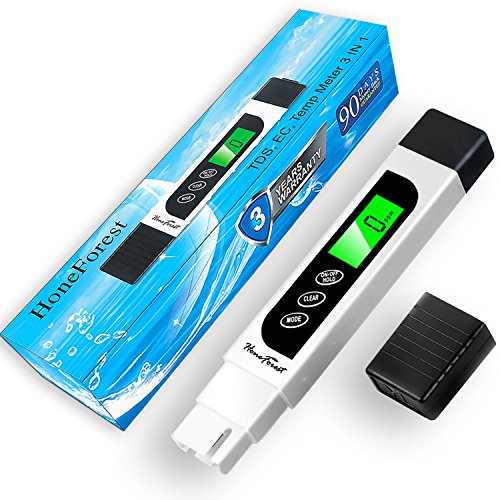
- Measures TDS, EC, and temperature
- Backlit LCD with auto-lock readings
- Useful for drinking water, RO/DI, and aquariums
Best For: Multipurpose routine water checks
Commercial-Ready Handheld

- 0–9,990 ppm range with 1 ppm resolution
- Plus or minus 2% stated readout accuracy
- Includes case, hold function, and thermometer
Best For: Portable commercial TDS measurements
Comprehensive Lab Kit

- Tests 63 drinking-water analytes
- Includes heavy metals, bacteria, and minerals
- Lab report targeted within five business days
Best For: Broad U.S. household contaminant screening
Budget TDS Tester

- 0–9,990 ppm TDS measurement range
- Large LCD with hold and auto-off functions
- Recalibratable and includes batteries
Best For: Affordable routine TDS checks
Best Budget TDS Meter

- Measures TDS, EC, and temperature
- Backlit display with color threshold prompts
- Useful for drinking water and RO/DI checks
Best For: Simple household and filter-monitoring tests
Best Multi-Parameter Pick

- Tests pH, TDS, EC, and temperature
- Includes calibration buffers and protective case
- Designed for hydroponics, aquariums, and pools
Best For: Users who need pH plus dissolved-solids readings
Best Advanced Option
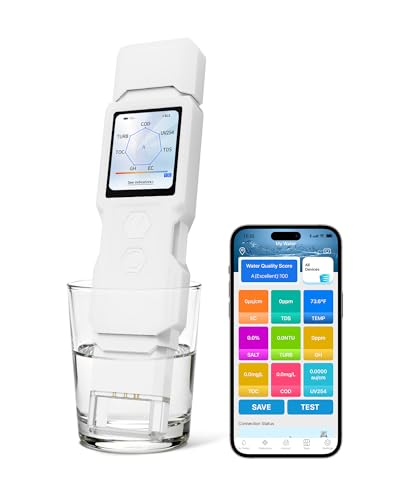
- Tests nine water-quality indicators
- Tracks results through Bluetooth and an app
- IP67-rated, compact, and field-friendly
Best For: Detailed multi-parameter monitoring and recordkeeping
Best All-Around Pick
4-in-1 TDS Water Quality Tester

- Measures TDS, EC, and temperature
- Large color-backlit LCD
- Includes battery and two-year warranty
Best For: Everyday multi-purpose water testing
Best Simple Starter
Varify 4-in-1 Digital Water Tester

- Fast TDS, EC, and temperature readings
- One-button operation with backlit LCD
- Includes batteries and TDS reference guide
Best For: Beginner home water testing
Best for Saltwater Testing
Hofun 5-in-1 Salinity and pH Meter
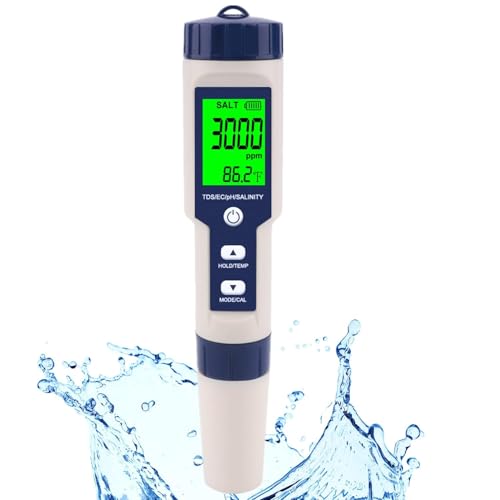
- Measures salinity, TDS, EC, pH, and temperature
- Displays PPM, PPT, and percentage salinity
- Designed for pools, aquariums, and seawater
Best For: Pool, aquarium, and saltwater monitoring
Versatile Digital Pick – HoneForest TDS, EC & Temperature Meter
For shoppers comparing water quality meters for testing, the HoneForest offers a convenient three-in-one approach. It measures TDS, electrical conductivity, and temperature, with a backlit display and readings that automatically lock after stabilization.
Best For: Checking drinking water, monitoring RO/DI systems, and testing aquariums, hydroponics, pools, and spas.
Pros:
- Measures TDS, EC, and temperature in one device.
- 0–9,990 ppm range with a titanium alloy probe and intelligent chip.
- Backlit LCD, auto-lock readings, automatic shutoff, and included carrying case.
Cons:
- Battery-powered operation requires keeping replacement batteries available.
- Measures dissolved solids and related readings rather than identifying specific contaminants.
The HoneForest is a practical multipurpose meter when you want fast numerical checks across several water-related tasks. It is less suited to comprehensive contaminant testing.
Commercial-Ready Handheld – HM Digital TDS-3 Meter
The HM Digital TDS-3 is a straightforward option among water quality meters for testing, offering a 0–9,990 ppm range, 1 ppm resolution, and stated readout accuracy of plus or minus 2%. Its hold function and carrying case support convenient field or commercial use.
Best For: Commercial users and anyone who wants a compact handheld TDS meter with a case and built-in thermometer.
Pros:
- Provides 1 ppm resolution across the lower portion of its range.
- Advanced microprocessor technology is designed for efficient, accurate readings.
- Includes hold, 10-minute auto-off, built-in thermometer, and belt-clip carrying case.
Cons:
- Focused on TDS and temperature rather than broad contaminant analysis.
- Listed battery life is approximately 3 hours.
Choose the TDS-3 if portability and a protective case matter, particularly for commercial workflows. Its measurement scope remains narrower than a laboratory water analysis kit.
Comprehensive Lab Kit – empowerDX Pro Water Test
Unlike handheld meters, the empowerDX Pro is an at-home laboratory kit for shoppers seeking water quality meters for testing that goes beyond TDS. It analyzes 63 parameters, including lead, other heavy metals, bacteria, minerals, fertilizers, and general water quality indicators, with results reported after lab processing.
Best For: U.S. households testing tap, city, well, filtered, rain, or other drinking-water sources for a broad range of contaminants.
Pros:
- Tests 63 analytes in a single kit.
- Samples are processed in a USA-based lab accredited to ISO/IEC 17025 and certified by EPA and NELAP.
- Includes collection materials, instructions, prepaid return shipping, and an actionable report targeted within five business days of sample delivery.
Cons:
- Available only to customers residing in the USA.
- Results are not immediate because samples must be mailed to the lab.
- Tests drinking-water samples rather than providing instant handheld readings.
This is the strongest choice here for broad contaminant screening and report-based guidance. It costs convenience in exchange for substantially more detailed analysis than a basic TDS tester.
Budget TDS Tester – HM Digital TDS-EZ
The HM Digital TDS-EZ is an economical choice among water quality meters for testing basic dissolved-solids levels. It covers 0–9,990 ppm, uses a large LCD, and includes a hold function, automatic shutoff, calibration capability, and a TDS chart sticker.
Best For: End users who want a simple, affordable meter for routine TDS checks on household water or filtration performance.
Pros:
- Measures from 0 to 9,990 ppm with 1 ppm resolution up to 999 ppm.
- Large LCD, hold function, and 10-minute auto-off support easy use.
- Includes batteries, can be recalibrated with a mini-screwdriver, and lists approximately 1,000 hours of battery usage.
Cons:
- Its stated readout accuracy is 3%, less precise than the HM Digital TDS-3.
- Resolution changes to 10 ppm from 1,000 to 9,990 ppm.
- Measures TDS only and does not test specific contaminants.
The TDS-EZ makes sense when low cost and simple operation are priorities. It is useful for trend checking, but a broad lab kit is more appropriate when you need contaminant-specific information.
Best Budget TDS Meter – 4-in-1 Digital Water Tester
For shoppers comparing water quality meters for testing, this compact 4-in-1 model focuses on the core readings many households need: TDS, EC, and temperature. Its backlit display, automatic hold function, and color prompts make quick checks convenient for drinking water and filtration systems.
Best For: Checking drinking water, RO/DI systems, filters, hydroponic solutions, pools, and spas.
Pros:
- Measures TDS up to 9,990 ppm, EC, and temperature in Celsius or Fahrenheit.
- Backlit screen automatically locks readings and uses green or red prompts around the 40 ppm threshold.
- Compact, lightweight design with included LR44 batteries and automatic shutoff.
Cons:
- Primarily measures dissolved solids, conductivity, and temperature rather than a broader range of water properties.
- The notes do not list a pH-testing function.
This is a practical choice when you want fast, readable TDS checks without a more complex testing setup. It is especially useful for monitoring whether an RO or DI filter may need attention.
Best Multi-Parameter Pick – VIVOSUN pH and TDS Meter
Among water quality meters for testing, the VIVOSUN stands out for combining pH measurement with TDS, EC, and temperature readings. Its broad pH range, calibration accessories, hold function, and protective case suit routine testing in home, aquarium, pool, and hydroponic settings.
Best For: Hydroponics, aquariums, swimming pools, laboratories, and general home water testing.
Pros:
- Measures pH from 0 to 14 with stated 0.01 pH accuracy.
- Includes a 3-in-1 TDS meter for TDS, EC, and temperature readings.
- Offers automatic temperature compensation, auto calibration, an LCD display, and a hold function.
- Comes with a protective case and three calibration buffers.
Cons:
- It cannot test seawater.
- Separate pH and TDS meters may require managing more than one testing device.
Choose this model if pH is as important to your testing routine as dissolved solids. The included calibration materials and case add convenience, while the stated seawater limitation is worth noting before purchase.
Best Advanced Option – 9-in-1 Smart Water Tester
For shoppers seeking more capable water quality meters for testing, this 9-in-1 smart tester adds turbidity, hardness, salinity, and optical measurements to common pH, TDS, EC, and temperature checks. Bluetooth app monitoring, automatic startup calibration, and a waterproof pen-style design make it suited to detailed household, field, and professional screening.
Best For: Drinking water, wells, tap water, aquariums, hydroponics, pools, outdoor screening, and basic laboratory testing.
Pros:
- Combines turbidity, hardness, pH, TDS, EC, salinity, TOC, COD, and UV absorbance testing.
- Bluetooth connectivity and the Kactoily app store results, create trend charts, and organize records.
- Uses automatic temperature compensation from 0–60°C and states measurement error of no more than ±2%.
- Compact 90-gram design with a backlit display and IP67 waterproof and dustproof rating.
Cons:
- Its broader feature set may be more than needed for simple TDS checks.
- App-based monitoring requires pairing with the dedicated Kactoily app.
- The supplied notes do not specify battery details or app compatibility beyond Bluetooth connectivity.
This is the most comprehensive option of the three for users who want multiple indicators and stored testing history. It makes particular sense when turbidity, hardness, or trend tracking matters alongside standard water readings.
Best All-Around Pick – 4-in-1 TDS Water Quality Tester
For shoppers comparing water quality meters for testing, this 4-in-1 model offers a practical mix of TDS, EC, and temperature readings in a compact handheld design. Its large color-backlit display, titanium probe, auto-shutoff, and included battery make it convenient for routine checks at home, with aquariums, hydroponics, RO systems, or pools.
Best For: Everyday multi-purpose water testing where quick readings and easy visibility matter.
Pros:
- Measures TDS, EC, and temperature in Celsius or Fahrenheit.
- Large dual-color backlit LCD is designed for clear day-or-night reading.
- Titanium probe, ABS housing, non-slip grips, and auto-shutoff support regular use.
- Includes a CR2032 battery and a two-year warranty with customer support.
Cons:
- It does not include a dedicated pH or salinity testing function.
- The color-alert thresholds may not suit every water-testing application.
This is a strong general-purpose choice if you want a straightforward meter with helpful display features and broad household applications. Buyers needing pH or detailed salt measurements should consider a more specialized multiparameter tester.
Best Simple Starter – Varify 4-in-1 Digital Water Tester
If you want water quality meters for testing that are easy to use without a complicated setup, the Varify 4-in-1 tester is a compact option. It provides TDS, EC, and temperature readings within seconds, while one-button operation, a backlit display, and a downloadable guide help simplify routine checks.
Best For: Beginners testing drinking water, aquariums, hydroponic systems, or RO water at home.
Pros:
- Combines TDS, EC, and Celsius/Fahrenheit temperature measurements.
- Offers fast digital readings with one-button operation.
- Titanium alloy probe and auto-off function support convenient everyday use.
- Includes batteries, a quick-start guide, and a downloadable TDS reference guide.
Cons:
- It does not measure pH or salinity.
- The supplied notes do not specify the measurement range or warranty length.
The Varify focuses on accessible, basic testing rather than advanced water analysis. It is a sensible pick for users who want quick TDS-related readings and guidance without adding extra functions they may not need.
Best for Saltwater Testing – Hofun 5-in-1 Salinity and pH Meter
Among water quality meters for testing, the Hofun stands out for users who need more than TDS and temperature readings. It combines salinity, TDS, EC, pH, and temperature functions, with display options for PPM, PPT, and percentage salinity across applications such as swimming pools, aquariums, seawater, spas, and hydroponics.
Best For: Pool owners, aquarium keepers, and users managing saltwater or pH-sensitive systems.
Pros:
- Combines salinity, TDS, EC, pH, and temperature in one meter.
- Supports PPM, PPT, and percentage salinity displays to reduce unit conversions.
- Offers salinity ranges for pool, seawater, and food-testing applications.
- Titanium alloy probe is designed for quick, accurate measurements.
Cons:
- Its broader feature set may be more than needed for basic drinking-water checks.
- The supplied notes do not list included batteries, calibration supplies, or a warranty.
This is the most versatile option in the group for saltwater and pH-related work. Its multiple modes can save time and avoid separate instruments, though buyers seeking only simple TDS testing may prefer a smaller, simpler meter.
How We Picked the Best Water Quality Meters for Testing
We selected products across several common testing categories rather than treating every device as interchangeable. The lineup includes basic TDS meters for fast dissolved-solids checks, combination meters that add EC and temperature, pH-focused tools, specialty saltwater testers, app-connected multiparameter instruments, and a broad at-home contaminant test kit.
Our comparison emphasizes measurement range, stated resolution and accuracy, supported parameters, ease of use, portability, and the intended application. We also considered whether a product is best suited to routine monitoring or occasional screening. A handheld TDS meter can be useful for comparing filtered and tap water, but it cannot identify specific contaminants such as lead or bacteria.
Quick Comparison
- Best for simple TDS checks: Choose a compact meter that displays TDS, with temperature included as a useful bonus.
- Best for hydroponics: Look for pH and EC functions, along with calibration support and a readable display.
- Best for pools and saltwater: Select a dedicated salinity and pH tester rather than relying on a TDS-only device.
- Best for broad household screening: Use a multiparameter kit that tests specific contaminants and follow-up laboratory testing when results are concerning.
- Best for data tracking: An app-connected meter can make it easier to monitor trends, provided its sensors are maintained and calibrated.
Key Buying Factors for Water Quality Meters for Testing
Parameters and Purpose
TDS measures the total amount of dissolved material, while EC measures electrical conductivity. These readings are useful indicators, but they do not reveal exactly which substances are present. For drinking-water concerns, a kit that tests named contaminants is more appropriate. For plants, aquariums, and pools, pH, EC, salinity, temperature, and hardness may matter more.
Accuracy, Range, and Resolution
Check the stated range and resolution against your application. A 1-ppm display resolution does not automatically mean laboratory-level accuracy. Also verify whether the instrument supports the levels you expect, especially for saltwater, concentrated nutrient solutions, or unusual water sources.
Calibration and Maintenance
Reusable meters require calibration, clean probes, and proper storage. Look for clear calibration instructions and replacement-probe availability. Rinse sensors with suitable water after use, avoid cross-contamination, and do not assume a reading is reliable if the probe is dirty or improperly stored.
Usability and Documentation
A backlit display, automatic temperature compensation, compact case, and simple controls can make frequent testing easier. For app-enabled products, consider connection reliability and whether the software provides useful history rather than just displaying live readings.
Who Should Buy Which Water Quality Meters for Testing?
Household filter owners who want quick before-and-after comparisons should start with a TDS meter. Hydroponic growers generally need a pH and EC combination meter, while aquarium and pool owners should prioritize the parameters specific to their water system, including salinity when applicable.
Buyers worried about drinking-water contaminants should choose a comprehensive test kit or arrange certified laboratory testing instead of relying on TDS alone. If results indicate a potential health risk, confirm them with an appropriate certified test before making treatment decisions.
